 Termite Registry
identification
Termite Holes in Wood and Drywall
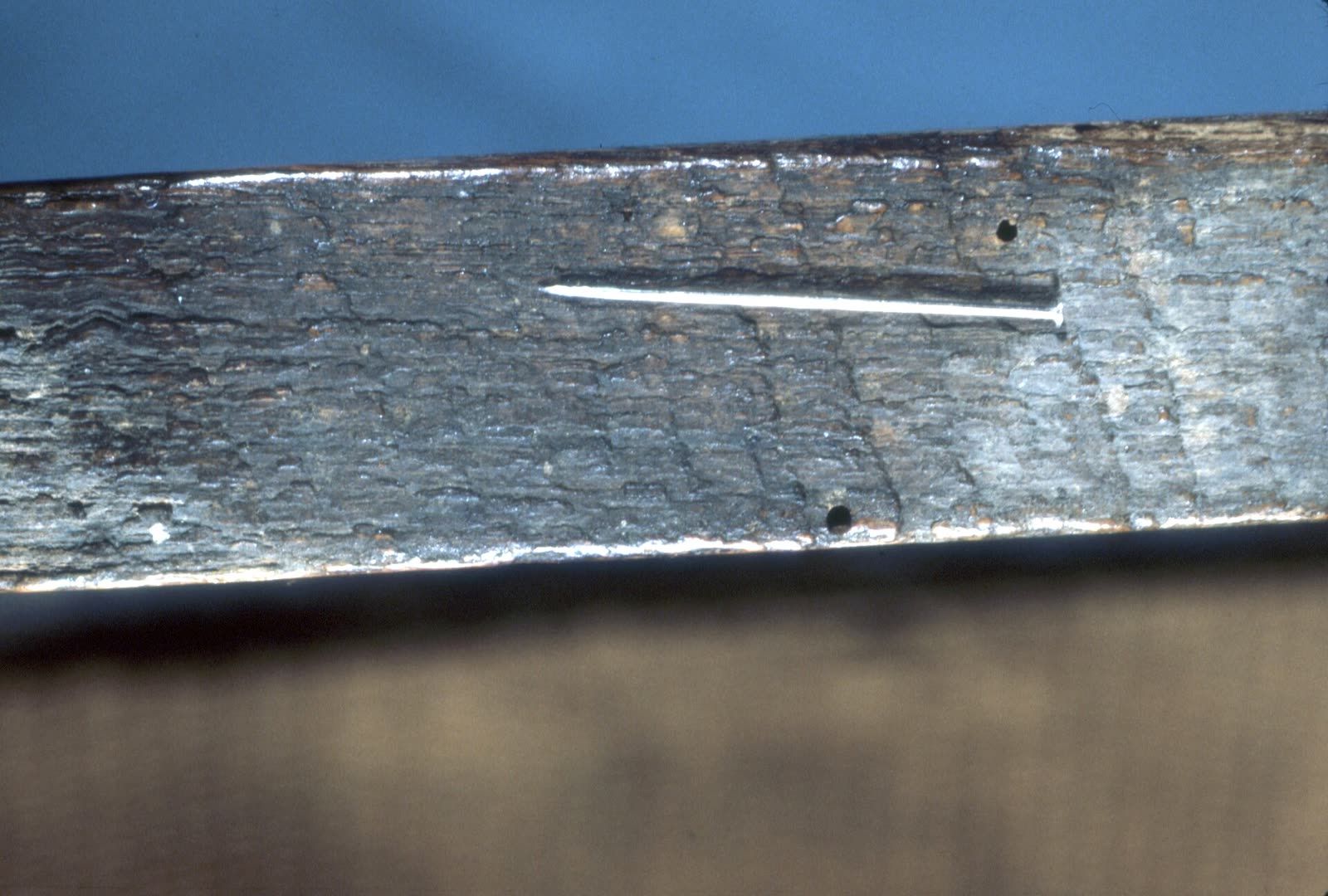

Termite holes are the kick-out holes drywood termites make to push pellets out of the wood: round, under 2 mm across, with hard pellets piled or scattered below. Subterranean termites leave mud, not open holes, so many of the holes people find were made by something else.
What do termite holes look like?
True termite holes are tiny, round exit points under 2 millimeters wide that drywood termites use to push fecal pellets out of their galleries.
The UC IPM Program says drywood termites push six-sided fecal pellets out of the wood through kickout holes less than 2 mm across. According to the University of Florida IFAS Extension, these kick-out holes usually measure 1 to 2 mm in diameter, and the thin surface wood or paint around them may show blistering or peeling.
A kick-out hole carries no mud. Arizona Cooperative Extension says the holes are round and the pellets collect in small piles below them, or scatter when the hole sits high above the surface.
Which insect made the hole?
The size of the hole and the material lying directly underneath it will tell you which insect created the opening.
| What you see | Size and shape | What is beside or under it | Most likely cause | Read next |
|---|---|---|---|---|
| Drywood kick-out hole | Round, under 2 mm (UC IPM) | Hard six-sided pellets piled or scattered below | Drywood termites | Frass guide |
| Powderpost beetle exit hole | Round “shot holes” (Kentucky ENTFACT-616); pinhead size for lyctids, 1/16 to 1/8 inch for anobiids | Fine flour-like or gritty powder | Powderpost beetles | |
| Carpenter bee hole | Clean round hole about 1/2 inch across | Coarse sawdust below, usually in bare softwood like fascia or deck rails | Carpenter bees | |
| Carpenter ant opening | Small slit-like openings rather than round holes | Coarse shavings that can hold insect parts | Carpenter ants | Ants vs termites |
| Subterranean swarm exit | Narrow slits or small openings in wood, drywall, slab cracks, or soil | Used once by swarmers and then sealed shut with soil by workers | Subterranean termites | Flying termites |
| Tiny drywall holes | Small pinholes through drywall or plaster with soil at the edge (Kentucky ENTFACT-604) | Bits of dried mud or soil around the margin | Subterranean termites | Termite damage |
| Row of plugged holes | Evenly spaced, neat drilled holes in wood, masonry, or slab | Plugs made of wooden dowels, plastic caps, or mortar | Past pest treatment | Termite bond |
The size of a hole narrows the list, and what lies beside it decides it. If the wood is already broken open, my guide to termite vs carpenter ant damage reads the galleries instead.
Do subterranean termites make holes?
Subterranean termites do not leave open holes in wood.
Subterranean termites dry out quickly in open air, so keep their galleries sealed and use soil or mud to plug any open gaps. Instead of creating open kick-out holes, they construct mud tubes across exposed foundations to move safely between the soil and their food source.
UF/IFAS Extension notes that residents often learn of an infestation when the annual flights of winged termites occur. Swarmers leave through narrow exit slits in wood, drywall or soil, and the workers seal these openings with soil once the flight ends. If you find shed wings near a sealed slit, review my guide on termite wings. An open hole that stays clean and unsealed is less likely to be theirs.
Termite holes in drywall and ceilings
Holes in drywall usually feature mud around the rim, while holes in ceilings scatter dry pellets onto the floor below.
University of Kentucky Entomology notes that termites occasionally bore tiny holes through drywall or plaster, leaving bits of soil around the outer margin. Kentucky adds that rippled or sunken traces behind wall coverings can show termites tunneling underneath.
When drywood termites infest ceiling joists or overhead trim, the pellets they eject fall through kick-out holes high above the floor. Arizona Cooperative Extension explains that pellets dropped from a great height scatter rather than pile. UF/IFAS Extension confirms that fecal pellets either accumulate in concentrated piles or scatter in wide circles based on the hole’s height above the floor. A hole lined with bits of soil points toward subterranean termites, while a clean hole with dry pellets below points toward drywood termites.
Holes left by a past treatment
A straight row of plugged holes in wood, concrete slabs, or foundation walls indicates a past chemical injection rather than active insect damage.
When a pest professional treats a structural infestation inside heavy timbers or behind walls, they drill access ports into the material. For instance, a borate product label specifies drilling small holes directly into infested wood to reach galleries inaccessible from the surface before injecting the chemical solution. In a 2009 field trial for the California Structural Pest Control Board, the average number of holes drilled for a local treatment ran from 34 to 91, depending on the product.
If you are buying a house and notice a row of sealed holes, ask the seller for the past treatment records and any active warranty. Line 2 of Box B on the NPMA-33 form lists exit holes among the evidence an inspector records, so a report can note old exit holes that a house has carried for years after the insects left.
Is the hole active or old?
Open holes alone do not prove insects are living inside them right now.
South Carolina’s inspection rule, S.C. Code Regs. 27-1085, says this plainly for powderpost beetles: “Emergence holes alone do not indicate activity nor does the presence of old dingy frass in emergence holes, galleries, or protected locations.”
For beetle damage, University of Kentucky Entomology guidelines explain that active holes spill fine powder the color of freshly sawed wood, while old abandoned holes take on a weathered look that matches the surrounding timber. If timber or trim was previously stained, newly chewed beetle exit holes show raw, unstained wood inside the rim. Note that this color test applies strictly to wood-boring beetles, not drywood termite pellets.
To check drywood termites, the UC IPM Program suggests cleaning up the pellets around a kickout hole and checking a few days later for new ones, though building vibration and movement can also make some pellets appear. South Carolina regulations establish that a repeated accumulation of pellets in the same area is a reasonable indication of an active drywood termite infestation.
Should I fill or spray the holes?
You should not fill or spray suspected termite holes before a professional inspection.
The holes and the debris beneath them are the evidence an inspector needs to identify the species. Patching a kick-out hole locks the evidence inside without reaching the colony inside the timber, and spraying consumer aerosol into an opening only kills the few insects near the surface.
University of Kentucky Entomology notes that wood-boring beetles damage timber slowly, making a wait-and-see approach reasonable when you are unsure if damage is active. South Carolina pesticide regulations similarly note that drywood termite damage accumulates slowly. Both mean you have time to get an inspection first.
If an inspector confirms an active infestation, treatment options range from a localized spot treatment to whole-structure fumigation. You can compare your options in my guide on tenting vs spot treatment or read my overview on how to get rid of termites.
What you should do next
Photograph the damage, monitor the area for fresh debris, and have an inspector examine the site.
I have not seen your house, but if you find unexplained holes in your timber or drywall, start by measuring the opening against something you have, such as a pin or a pencil tip. Take clear photos of the hole, the surrounding wood surface, and any dust or pellets on the floor beneath it.
Sweep away any debris under the hole, leave the area undisturbed, and check back in a few days to see if new powder or pellets gather, knowing that vibration can shake old pellets loose. Do not seal, caulk, or spray chemical aerosols into the opening during this monitoring window. Finally, book a professional termite inspection and share your photos and notes so the inspector can make an accurate call.
Sources
- Pest Notes: Drywood Termites (Publication 7440) — UC Statewide IPM Program, 2014. Accessed 2026-10-16.
- West Indian Drywood Termite, Cryptotermes brevis (EENY-079) — University of Florida IFAS Extension, Featured Creatures, undated. Accessed 2026-10-16.
- Drywood Termites (AZ1232) — University of Arizona Cooperative Extension — Dawn H. Gouge, Carl Olson, Paul Baker, 2009-05. Accessed 2026-10-16.
- Drywood Termites (E-366) — Texas Cooperative Extension — Roger E. Gold, Harry N. Howell Jr., Grady J. Glenn and Kimberly M. Brown, 2005-12. Accessed 2026-10-16.
- Termite Control: Answers for Homeowners (ENTFACT-604) — University of Kentucky Department of Entomology — Michael F. Potter, 2026-03. Accessed 2026-10-16.
- Powderpost Beetles (ENTFACT-616) — University of Kentucky College of Agriculture — Michael F. Potter, 2026-03. Accessed 2026-10-16.
- Rules and Regulations for the Enforcement of the South Carolina Pesticide Control Act, S.C. Code Regs. 27-1085(K), Wood Infestation Report (Revised July 2024) — South Carolina Department of Pesticide Regulation, Clemson University, 2024-07. Accessed 2026-10-16.
- Form NPMA-33: Wood Destroying Insect Inspection Report (7/01/19) — National Pest Management Association, hosted by US Department of Housing and Urban Development, 2019-07-01. Accessed 2026-10-16.
- Native Subterranean Termites: Reticulitermes flavipes, R. virginicus, R. hageni (EENY-212) — University of Florida IFAS Extension, Featured Creatures, undated. Accessed 2026-10-16.
- Pesticide product label, Bora-Care, EPA Reg. No. 64405-1 — Nisus Corporation, 2023-08-04. Accessed 2026-10-16.
- Field Evaluations of Localized Treatments for Control of Drywood Termite Infestations in California — University of California Berkeley — Vernard R. Lewis, Sara Moore, Robin Tabuchi and Gail Getty, for the California Structural Pest Control Board, 2009. Accessed 2026-10-16.
Common questions
What does a termite burrow look like?
Drywood termites leave smooth galleries inside the wood with small round kick-out holes to the surface. Subterranean termites leave galleries packed with soil and reach the wood through mud tubes, so you rarely see an open hole from them.
How do I know if termite holes are active or old?
A hole alone cannot tell you. South Carolina's inspection rule says beetle emergence holes alone do not show activity, and for drywood termites it looks for pellets that keep coming back. Sweep the surface below and look again in a few days; new pellets point to activity, though building vibration can shake old ones loose.
Can I treat termite holes myself?
Filling or spraying a hole reaches only the termites the product touches, and it removes the evidence an inspector needs. Photograph the holes, leave them as they are, and book an inspection first.
- termite holes
- kick-out holes
- exit holes
- identification
Related reading
identification
Signs of Termites in the House: What Each Means
A sign of termites is a physical trace the insects left behind, not the insects themselves. Every sign below is worth acting on, and the two you are most likely to find, a mud tube and a pile of…
identification
Termite Damage: What It Looks Like and What to Do
Termite damage is wood eaten out from the inside, hollowed along or across the grain and lined with soil or pellets. By the time it shows on the outer surface, the wood behind it is already thin.
identification
Termite Droppings (Frass) vs Sawdust
A small pile of wood debris on your floor is almost never sawdust. It is insect droppings, excavation waste, or beetle powder, and of the four things that leave a pile like that, drywood termite…