 Termite Registry
identification
Termite Mud Tubes: What They Are and What to Do
A termite mud tube, or shelter tube, is a covered runway of hardened earth that subterranean termites build so they can travel between the soil they live in and the wood they are eating. University of Florida IFAS Extension entomologists call these tubes the equivalent of highways connecting the underground termite population with aboveground food sources. Finding one means subterranean termites reached that spot. It cannot tell you whether they are still using it.
What is a mud tube and what is it made of?
A mud tube is made of soil, saliva, and bits of wood. UC IPM describes these earth-hardened tubes as the work of the colony’s workers, mixing saliva with soil and wood fragments or even drywall, and calls them the most commonly seen evidence of a subterranean termite infestation. Kentucky’s extension says the termites construct them for shelter as they travel between their underground colonies and the structure. The Environmental Protection Agency puts the consequence plainly: termites rarely emerge from soil, mud tubes, or the wood they are tunneling through, so the tube is usually the first thing anybody sees.
Drywood termites build no tubes at all, and push six-sided fecal pellets out of tiny kickout holes instead. If you are trying to settle which group you have, my guide on subterranean vs drywood termites is the one that does it. If you would rather work from what is on your wall, my termite scan routes a visible sign to the right page, and my guide to the signs of termites covers the ones that are not tubes.
What do termite mud tubes look like and where do they run?
Mud tubes look like narrow crusted lines of dried dirt stuck to a building surface. Kentucky’s extension puts the size at about the diameter of a pencil, and says they are sometimes thicker.
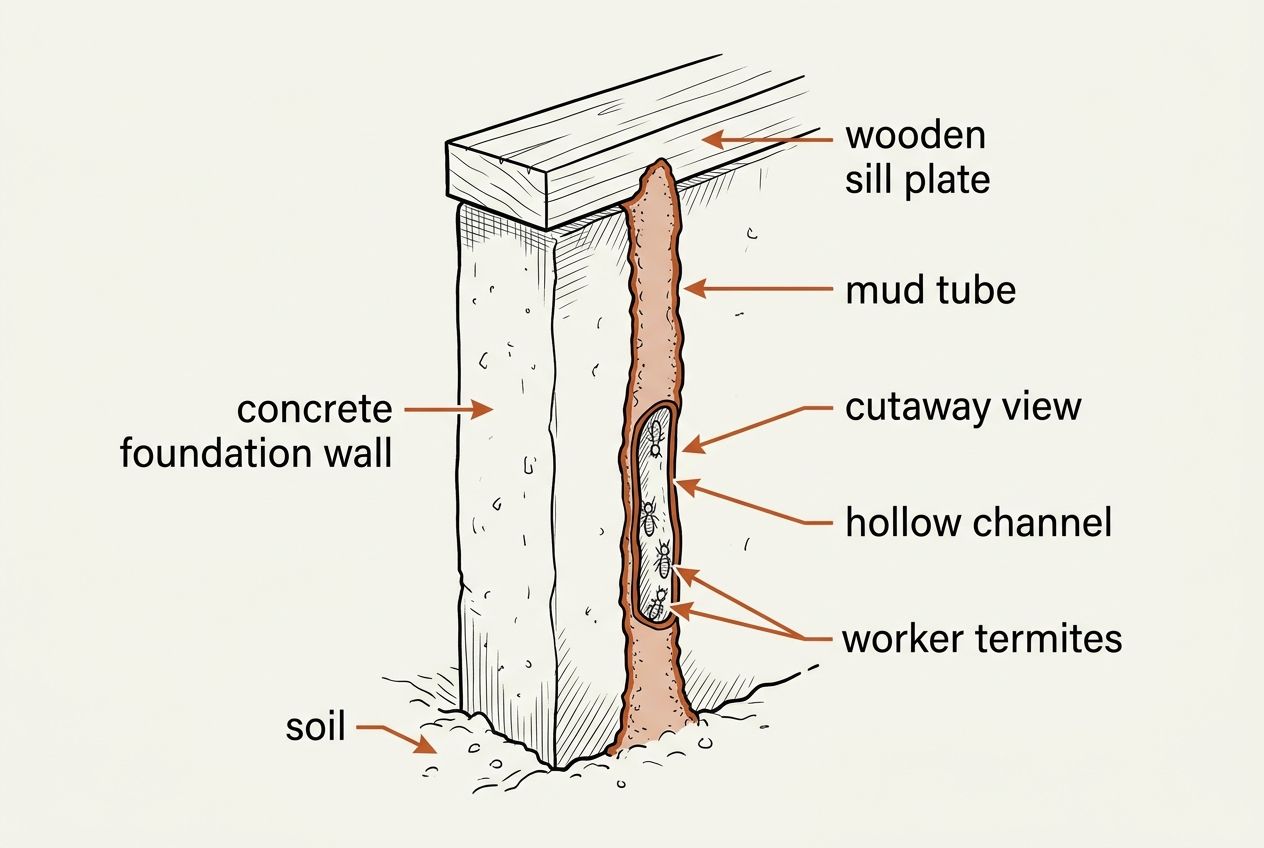
Kentucky also names where they run: over foundation walls, support piers, sill plates, and floor joists. Those are the four places to check first, and they are the four spots where the framing sits closest to the ground. If you open the damaged wood itself, Kentucky says the galleries inside are hollowed out along the grain and lined with bits of dried mud or soil, so the same material shows up in both places.
Checking all four takes one slow pass round the house with a torch held low. The inspection checklist you can print puts them in the order you actually reach them, with the crawlspace items separated out.
What are the four kinds of termite mud tubes?
UC IPM identifies four distinct types of shelter tubes, and only one of them actually runs from the soil straight into your structural wood. Knowing which type sits on your wall tells you how the insects are accessing the house:
- Working tubes: These travel from the nest in the soil to wooden structures, often running straight up concrete or stone foundations. Finding a working tube means termites have an established transit line directly into your wood framing.
- Exploratory and migratory tubes: These arise from the soil but do not connect to any wooden structure. A tube that reaches nothing is still a termite tube. UF/IFAS gives the reason one gets built: a single colony of the eastern subterranean termite may hold 100,000 to 1,000,000 termites and forage up to 150 feet looking for food, so tubes that find nothing are a normal part of how the colony searches.
- Drop tubes: These extend downward from wooden structures back toward the soil. If you spot a drop tube hanging from a floor joist, termites reached that wood through a different entry path than the wall you are examining.
- Swarm tubes: These short tubes are built specifically for new reproductive kings and queens to emerge from and fly away during swarm season.
How do termites get through a concrete foundation?
Termites do not go through concrete, they go through a gap in it. The North Carolina Department of Agriculture & Consumer Services Structural Pest Control Division reports that termites need only a 1/32-inch crack in a mortar joint or concrete expansion joint to enter a structure.
The same guide says research has shown termites can build tubes at approximately two and a half inches per hour, which is why it warns that termites can turn up shortly after a house has been inspected. UC IPM adds the part that surprises people most: where untreated wood sits above chemically treated wood, subterranean termites can build their shelter tubes straight over the treated wood and infest what is above it.
My read of those three facts together is that a mud tube on your foundation is not evidence the house was built badly. A 1/32-inch crack in a mortar joint is smaller than anything a builder is aiming at, and a treated section only helps if there is nothing above it worth reaching.
How to tell if a mud tube is active?
Break open a small section and look inside. Kentucky’s extension recommends exactly that, checking the opened tube for small creamy-white worker termites, and UC IPM says you may see live workers and soldiers running through it.
That test runs in one direction only, and Kentucky says so in the sentence straight after. A vacant tube does not necessarily mean the infestation is inactive, because termites often abandon sections of tube while foraging elsewhere in the structure. So live workers settle the question and an empty tube does not touch it. If you break one open and find nothing, you have learned that this particular stretch is not in use today, and nothing about the rest of the house.
Should I knock down a termite mud tube?
You can destroy shelter tubes between soil and wood structures to break their travel path, but doing so will not eliminate the underground colony. UC IPM advises homeowners to destroy shelter tubes built between soil and wooden structures wherever possible.
That interrupts access to the wood above, and it is worth doing. It treats nothing, because the colony is in the soil rather than in the tube. It also settles nothing either way, and North Carolina’s two-and-a-half-inches-an-hour figure is why: my read is that at that rate you should expect a rebuilt tube, so neither its return nor its absence tells you much. Photograph where it ran before you touch it. Once the tube is off the wall, the route it took is gone, and that route is one of the things an inspector will ask about.
What should you do after finding a mud tube?
Here is the order I would work in. Photograph the tube where it is, wide enough to show what it runs between, and write down the room, the height, and the direction it ran. Then break a short section and look for live workers, and leave the rest of it on the wall. An inspector arriving to a scraped foundation has lost the map.
Then book a termite inspection. My guide on how to vet a pest control company covers what to check about the company before you call one. Nobody should be rushing you: the University of Kentucky says termites damage wood slowly, and that an extra day, week, or month spent making an informed decision is generally inconsequential.
For the next time, UF/IFAS makes the point that keeping the lower foundation walls and siding clear of vegetation and mulch is what makes shelter tubes easy to spot in the first place. That is the cheapest thing on this page and it is covered further in my guide to termite prevention; what happens after an inspection is on the termite treatment hub. I have not seen your foundation, and the one thing I would not do is agree to any work before somebody who has seen it has told you what is there.
Sources
- Pest Notes: Subterranean and Other Termites (Publication 7415) — UC Statewide IPM Program, 2014-05. Accessed 2026-08-07.
- Termite Control: Answers for Homeowners (ENTFACT-604) — University of Kentucky Department of Entomology — Michael F. Potter, 2026-03. Accessed 2026-08-07.
- Native Subterranean Termites: Reticulitermes flavipes, R. virginicus, R. hageni (EENY-212) — University of Florida IFAS Extension, Featured Creatures, undated. Accessed 2026-08-07.
- A Home Buyer’s Guide for Wood Destroying Insect Information Report (WDIR) — North Carolina Department of Agriculture & Consumer Services, Structural Pest Control Division, undated. Accessed 2026-08-07.
- Pest Notes: Drywood Termites (Publication 7440) — UC Statewide IPM Program, 2014. Accessed 2026-08-07.
- Termites: How to Identify and Control Them — US Environmental Protection Agency, 2025-10-21. Accessed 2026-08-07.
Common questions
Are mud tubes always termites?
A mud tube of the kind described here is the most commonly seen evidence of subterranean termites, and UC IPM treats it that way. What it cannot do is tell you the infestation is live, or tell you where in the structure the colony is feeding. Treat the tube as a reason to get the house inspected rather than as the identification itself, and leave the identification to someone who can get to the parts of the house you cannot.
How do I tell if a mud tube is active?
Break a section open and look for small creamy-white workers. Kentucky's extension recommends exactly that, and UC IPM says you may see workers and soldiers running through the tube. If you find live termites, that settles it. If you find nothing, it settles nothing, because Kentucky says termites often abandon sections of tube while foraging elsewhere in the same structure. The test only works in one direction.
Should I knock the mud tubes down?
UC IPM does say to destroy shelter tubes between soil and wood wherever you can, because it interrupts the colony's access to the wood underneath. What knocking one down does not do is treat anything or prove anything, and a rebuilt tube is not a fresh infestation. Photograph the tube where it is before you touch it, because where it ran is information an inspector will want and you cannot get it back.
How did termites get through a solid concrete foundation?
They did not go through it, they went through a gap in it. North Carolina's structural pest control division says termites need only a 1/32 of an inch crack in a mortar joint or a concrete expansion joint to enter a structure. UC IPM adds that where untreated wood sits above treated wood, they will build their tubes straight over the treated section. A poured wall is a barrier with joints in it, and the joints are the route.
- mud tubes
- identification
- subterranean
- foundation
Related reading
identification
Carpenter Ants vs. Termites: Telling Them Apart
Termites are insects that eat wood for the cellulose in it; carpenter ants are large ants that do not eat wood at all, but tunnel into it to make a nest and dump the shavings back out.
identification
Subterranean vs Drywood Termites: Which You Have
Subterranean termites nest in the soil and reach your wood through mud tubes; drywood termites live entirely inside dry wood and touch no soil at all.