 Termite Registry
identification
Termite vs Carpenter Ant Damage: Reading the Wood
Opening a wall during a remodel or pulling back trim often reveals damaged timber with no insect anywhere in it. What sits inside the galleries names the insect, and how smooth the walls are does not: smooth walls separate carpenter ants from subterranean termites and do not separate them from drywood termites at all.
Which insect did this?
The contents left inside excavated wood channels identify the insect long after the pests themselves have departed.
Kentucky’s extension service points out that termite feeding and damage often progress undetected in exposed wood because the outer surface usually stays intact, which is why damage rarely appears on a list of the signs of termites a homeowner spots first. Homeowners usually discover chewed timber when opening up a wall during a remodel rather than while the damage is occurring. If you happened to catch living bugs in the framing rather than just empty tunnels, you can use my guide on telling carpenter ants and termites apart to identify the insect by its body shape.
When looking at empty timber, you are often looking at historical water damage alongside insect activity. Penn State Extension notes that carpenter ants usually will not infest wood that is sound and has a moisture content below 15 percent, directing owners to check damp areas like leaking roofs, defective flashing, overflowing gutters, or leaking pipes. Kentucky’s extension adds that while carpenter ants typically inhabit moist wood, they have the ability to expand into undamaged timber. UC IPM confirms that a carpenter ant nest network often begins where water or decay did initial damage. The moisture problem usually came first, creating the conditions that attracted the insects.
What does termite damaged wood look like inside?
Subterranean termite damage is layered wood hollowed along the grain and lined with dried mud. Drywood termite damage cuts across the grain and holds hard six-sided pellets.
The internal structure depends entirely on which termite group excavated the timber:
- Subterranean termites: UC IPM explains that subterranean termites feed along the grain of the wood, attacking the softer springwood and leaving the harder summerwood intact. Texas A&M describes this exact pattern as alternating layers of damaged and undamaged wood. Kentucky’s extension notes that the galleries are hollowed out along the grain and lined with bits of dried mud or soil. Soil inside the galleries combined with a layered appearance is a decisive indicator of subterranean termites. Learn more in my breakdown of subterranean termites.
- Drywood termites: UC IPM notes that drywood termites cut across the grain, carving out interconnected chambers and tunnels. Texas A&M explains why they look different inside: these termites consume both the soft springwood and the harder summerwood, which gives the galleries a smooth sculptured appearance, and the galleries contain fecal pellets. Arizona’s bulletin describes the same smooth, sculptured chambers cutting across the grain. UF/IFAS Extension adds that drywood termites prefer sapwood and that blistering or peeling of thin surface wood or paint can be the external sign of damage underneath. Arizona’s bulletin notes that pellets can accumulate in blind galleries or unused tunnels rather than spreading uniformly. You can read my overview of drywood termites or my comparison of subterranean vs drywood termites.
- Formosan termites: Texas A&M gives the one line that matters here. Formosan termites consume summerwood as drywood termites do, so the galleries look similar, but they contain no fecal pellets. That is a smooth gallery with nothing in it, which is also what a carpenter ant leaves, so this is the one pair the contents test does not split. My page on Formosan termites has the rest.
What do carpenter ant galleries look like?
Carpenter ant galleries are clean channels with smooth sides and nothing in them: no soil, no mud, no pellets.
Penn State Extension explains why they are empty. Carpenter ants do not consume the wood as food, so the excavated particles get dumped outside the nest, turning up as piles of coarse stringy wood particles, dead insect parts, and other debris sifting from cracks in the siding, behind moldings, in the basement and attic, and under porches. UC IPM adds that carpenter ant sawdust is fibrous, against the six-sided pellets of drywood termites. So the material that would tell you which insect it was is on the floor rather than in the wood, which is what makes the gallery itself so unhelpful on its own. If there is still a pile under the damage, my guide to termite droppings versus sawdust is where that gets sorted out.
Do smooth galleries mean carpenter ants?
Smooth gallery walls only separate carpenter ants from subterranean termites, because drywood termites also carve smooth, sculptured tunnels through timber.
A common shortcut in home maintenance advice is that smooth galleries mean carpenter ants and rough galleries mean termites. Penn State Extension does state that, unlike termites, carpenter ant galleries are smooth-sided and contain no soil particles or fecal pellets. If you are comparing ants strictly to subterranean termites, that rule works.
However, Texas A&M explicitly writes that drywood termites consume both springwood and summerwood, giving their galleries a smooth sculptured appearance. The University of Arizona confirms this, describing drywood termite galleries as having a smooth, sculptured appearance that cuts across the wood grain. Smooth gallery walls do not separate ants from drywood termites at all.
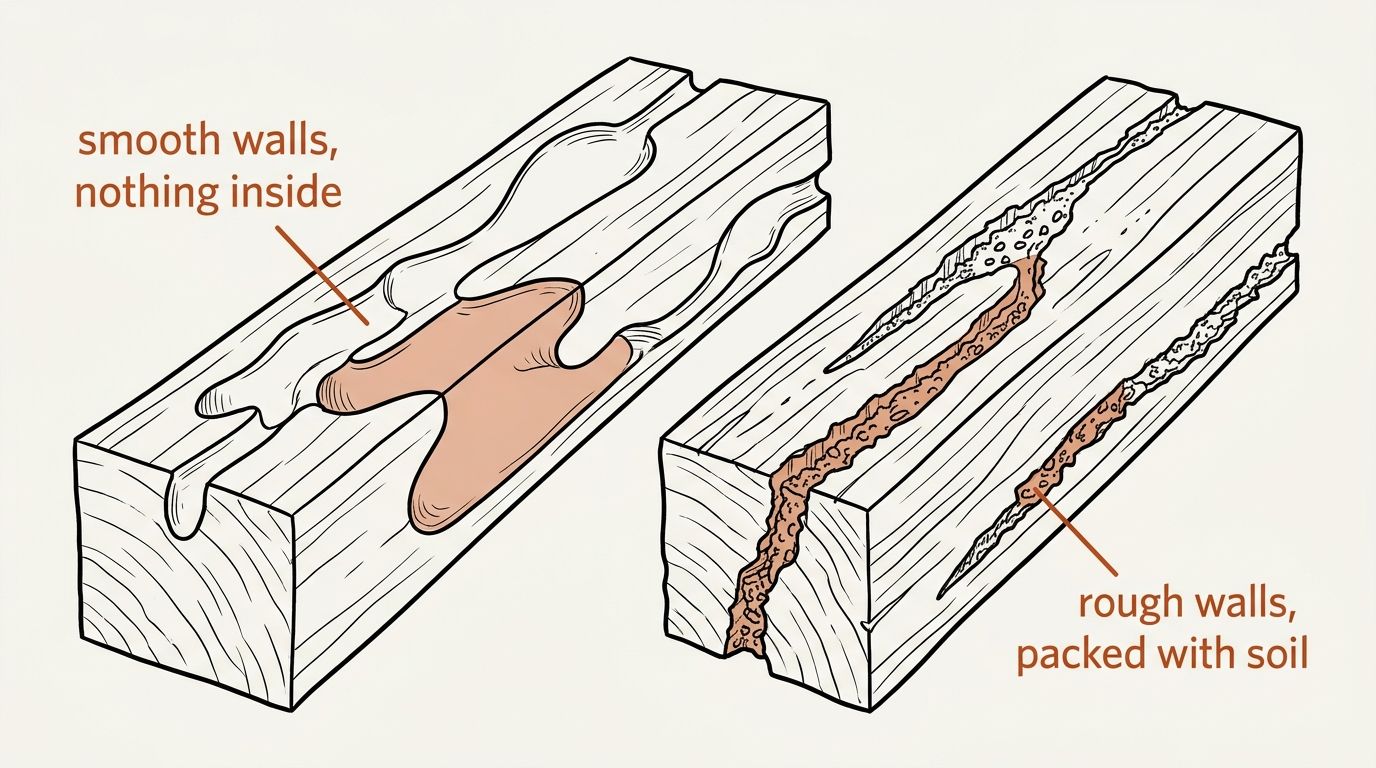
What separates them is what sits inside the hollowed space. Mud and soil indicate subterranean termites, six-sided pellets indicate drywood termites, and a completely clean gallery with fibrous sawdust dropped outside indicates carpenter ants.
| Insect | What the wood does | Interior surface | Inside the gallery |
|---|---|---|---|
| Subterranean termite | Follows the grain: springwood eaten, summerwood left, so the damage looks layered | Not smooth | Dried mud and soil |
| Drywood termite | Cuts across the grain into chambers and tunnels | Smooth and sculptured | Six-sided fecal pellets |
| Formosan termite | Eats summerwood as drywood termites do | Smooth and sculptured | No fecal pellets |
| Carpenter ant | Nests in existing voids and in wood that decay already softened | Smooth-sided | Nothing: the shavings are dumped outside |
How bad is carpenter ant damage?
The severity of carpenter ant damage depends on the size of the colony and whether the wood was already weakened by decay.
Two extension services describe carpenter ant damage differently, and both are right about different home situations:
- Penn State Extension states that in homes, ants typically do not excavate wood for nest construction, preferring hollow areas in ceilings, walls, or floors. They note that while ants will tunnel through sound structural timbers to reach a void on the other side, this has little effect on the structural integrity of the timber.
- UC IPM notes that a large colony’s network of galleries often begins in water-damaged or decayed wood, but from there, the ants can expand into sound wood and compromise structural integrity. Kentucky’s extension concurs, stating simply that the larger the colony, the more significant the damage caused.
My read of these sources is that colony size and pre-existing moisture determine which scenario you face. A small satellite nest tunneling through framing to reach a wall void causes negligible structural change. A massive, established parent colony expanding out of damp, rotting wood into sound framing can compromise structural strength over time. Neither extension service is describing the other’s scenario.
Can you tell how old the damage is?
You cannot determine the exact age of termite damage from the visual appearance of the wood alone.
Kentucky’s extension states that dating the onset of termite damage is a hard thing to determine, particularly when homeowners try to figure out whether damage occurred before or after a treatment warranty took effect. Texas A&M adds that verifying the effectiveness of drywood termite treatments is inherently difficult because the insects remain concealed inside the wood.
For older structures, North Carolina’s Structural Pest Control Division offers practical context. North Carolina notes that most homes in the state over ten to fifteen years old will have some evidence of wood-destroying insects and could well have been damaged by them. The division states that a buyer must be willing to accept some insect damage in an older home, comparing it to accepting a few minor dents on a used car.
Who is qualified to assess it?
A structural engineer, a contractor, or another building expert, and North Carolina’s regulator says so in as many words.
North Carolina’s Structural Pest Control Division makes this explicit for real estate inspections: a pest control operator issuing a report is not required to report the presence or extent of structural damage. The report is strictly an inspection for insect presence, not a structural damage report. North Carolina states flatly that a pest control operator is ordinarily neither prepared nor qualified to evaluate the extent of damage to a structure, and that such evaluations should be left to a structural engineer, contractor, or other building expert.
That is worth holding on to, because the person who found your damage is often the person you then ask about it. If this turned up during a sale, my page on the termite inspection covers what the visit is for, what happens after a failed termite inspection covers the transaction, and what a WDI report means covers what the document does and does not say about damage.
What should you do about damaged wood?
I have not seen your home or the exposed timber in your wall, but here is how I would handle discovered wood damage.
First, take clear, well-lit photographs of the damage from several angles before anyone cuts away the wood or seals the wall back up. Write down where the damaged beam sits, whether the wood feels damp to the touch, and whether you see mud, dry pellets, or empty clean channels inside the timber.
Second, call two different people, and let what you found inside the galleries decide the order. Mud, pellets, or anything that looks like live activity, and the pest control operator goes first, because that is the question they are licensed to answer. Empty clean channels in wood that was wet, and the structural side goes first, because the ants may be the smaller half of what you are looking at.
Either way, the structural question does not go to the pest operator. North Carolina is explicit that it is not their job and not their expertise, and a written assessment from an engineer or a contractor is the thing that tells you whether the framing needs work. My guide on how to vet a pest control company covers the other half of that call.
Kentucky’s extension says termites damage wood slowly, and that an extra day, week, or month spent making an informed decision is generally inconsequential. That applies here more than almost anywhere, because you are about to buy two opinions rather than one.
Sources
- Pest Notes: Subterranean and Other Termites (Publication 7415) — UC Statewide IPM Program, 2014-05. Accessed 2026-08-07.
- Drywood Termites (E-366) — Texas Cooperative Extension — Roger E. Gold, Harry N. Howell Jr., Grady J. Glenn and Kimberly M. Brown, 2005-12. Accessed 2026-08-07.
- Drywood Termites (AZ1232) — University of Arizona Cooperative Extension — Dawn H. Gouge, Carl Olson, Paul Baker, 2009-05. Accessed 2026-08-07.
- Carpenter Ants — Penn State Extension, 2026-06-24. Accessed 2026-08-07.
- Pest Notes: Carpenter Ants (Publication 7416) — UC Statewide IPM Program, undated. Accessed 2026-08-07.
- Carpenter Ants (ENTFACT-603) — University of Kentucky Department of Entomology — Allison Lopina and Zach DeVries, 2026-03. Accessed 2026-08-07.
- Termite Control: Answers for Homeowners (ENTFACT-604) — University of Kentucky Department of Entomology — Michael F. Potter, 2026-03. Accessed 2026-08-07.
- A Home Buyer’s Guide for Wood Destroying Insect Information Report (WDIR) — North Carolina Department of Agriculture & Consumer Services, Structural Pest Control Division, undated. Accessed 2026-08-07.
- West Indian Drywood Termite, Cryptotermes brevis (EENY-079) — University of Florida IFAS Extension, Featured Creatures, undated. Accessed 2026-08-07.
Common questions
Is it termites or carpenter ants if the tunnels look clean and smooth?
Smooth walls rule out subterranean termites and do not rule out drywood termites. Penn State says carpenter ant galleries are smooth-sided with no soil or pellets in them, but Texas A&M and Arizona's extension both describe drywood termite galleries as smooth and sculptured too. Look at what is inside instead. Hard six-sided pellets mean drywood termites, soil means subterranean termites, and an empty smooth chamber points at ants.
Can anyone tell how old termite damage is?
Not reliably, and Kentucky's extension says so in the context of warranties: dating the onset of termite damage is a hard thing to determine, which is exactly why repair coverage is argued over. North Carolina's regulator adds the perspective that helps most, that most homes there over ten to fifteen years old will show some evidence of wood-destroying insects. Old damage in an older house is normal. What it does not tell you is whether anything is still feeding.
The pest inspector said there is damage. Should they tell me how bad it is?
They are not the right person to ask, and North Carolina's structural pest control division says it plainly: an operator is ordinarily neither prepared nor qualified to evaluate the extent of damage to a structure, and the report is not a structural damage report. The inspector's job is to say the evidence is there and where. Working out what it means for the building is a structural engineer's or a contractor's call.
Carpenter ants do not eat wood, so does the damage matter?
It depends on the colony and on how wet the wood already was, and two extension services describe it very differently. Penn State says ants in homes typically nest in existing voids, and that tunneling through sound timber to reach one has little effect on the timber's structural integrity. UC IPM says a large colony can start in water-damaged wood and expand into sound wood and compromise it. Both are describing real situations, and the size of the nest is what decides which you have.
- wood damage
- carpenter ants
- identification
- galleries
- structural
Related reading
identification
Carpenter Ants vs. Termites: Telling Them Apart
Termites are insects that eat wood for the cellulose in it; carpenter ants are large ants that do not eat wood at all, but tunnel into it to make a nest and dump the shavings back out.
identification
Subterranean vs Drywood Termites: Which You Have
Subterranean termites nest in the soil and reach your wood through mud tubes; drywood termites live entirely inside dry wood and touch no soil at all.