 Termite Registry
Localized Spot Treatment
Spot treatment means treating the specific piece of wood the termites are in, instead of the whole building. For drywood termites it is the popular choice, accounting for at least 70% of the California market by one estimate in a state-funded study.
Whether it works comes down to one thing, and UC IPM puts it plainly: “if you correctly locate the colony and get the chemical or nonchemical treatment directly onto the termites, the effectiveness of control will be high.”
The catch is in the first four words.
What it costs
Researchers at the University of Hawaii describe localized injection as “the most economical and popular alternative” to fumigation, which is the comparison most people are actually making.
One cost gets left out of quotes. UC IPM notes that if the infested wood is load-bearing, “either an architect, engineer, and/or general contractor should be consulted; and building permits may be necessary, adding expense.” A cheap-sounding board replacement can turn into a permit.
What it actually does
The category covers several different things. Chemical versions inject liquid, foam or dust into galleries through drilled holes. Borate products soak into bare wood. Physical versions use localized heat, high-power microwaves, or electrocution at around 90,000 volts and less than half an amp.
All of them share one dependency: somebody has to find the galleries and get the treatment into them. The XT-2000 orange oil label states this as a directive, “Applicator must locate termite galleries,” and lists visual signs, fiber optics, listening devices and tapping wood with a screwdriver as the ways to try.
Borates carry a specific and much-misunderstood limit. The Bora-Care label states no penetration depth anywhere in its thirteen pages, and what it does say is that “Heartwood is not penetrated quickly.” Work summarized by the Bio-Integral Resource Center found that surface applications of borate “did not kill any termites in the laboratory, because galleries were deeper in the wood than the penetration distance of the borate.” Borates are strongest as prevention on bare wood, not as a rescue for a colony already deep inside a beam.
What the evidence actually shows
This is where the page earns its keep, because the published record is not what a sales visit suggests.
The California Structural Pest Control Board funded a field study of six localized products against natural infestations in homes and commercial buildings across fourteen cities. One licensed applicator did every application, at maximum label rates. The result, in the authors’ own words:
“At the end of three months, although most product treatments had reduced termite-feeding activity, the reduction was not significantly different from untreated checks.”
Laboratory work fills in what field conditions obscure. In the companion UC Riverside study, products injected into naturally infested boards every 18 inches produced worker mortality of 91.9% for fipronil, 73.2% for a thiamethoxam foam, 51.4% for orange oil and 20.3% for a borate liquid, against almost nothing in the untreated controls. Those are boards on a bench rather than houses, and the spread between products is real.
A 2012 trial stacked the deck in favor of spot treatment: galleries located with a motion detector and a resistance drill, boards accessible from every side, ready-to-use products. Even then, “no formulation eliminated infestations in every board that was treated.”
A Hawaii study reached the same place from a different direction. Twelve months after injection, “none of the insecticidal treatments resulted in significant termite mortality,” and the authors named the reason: “The weakness of all localized insecticide injections was clearly site selection.”
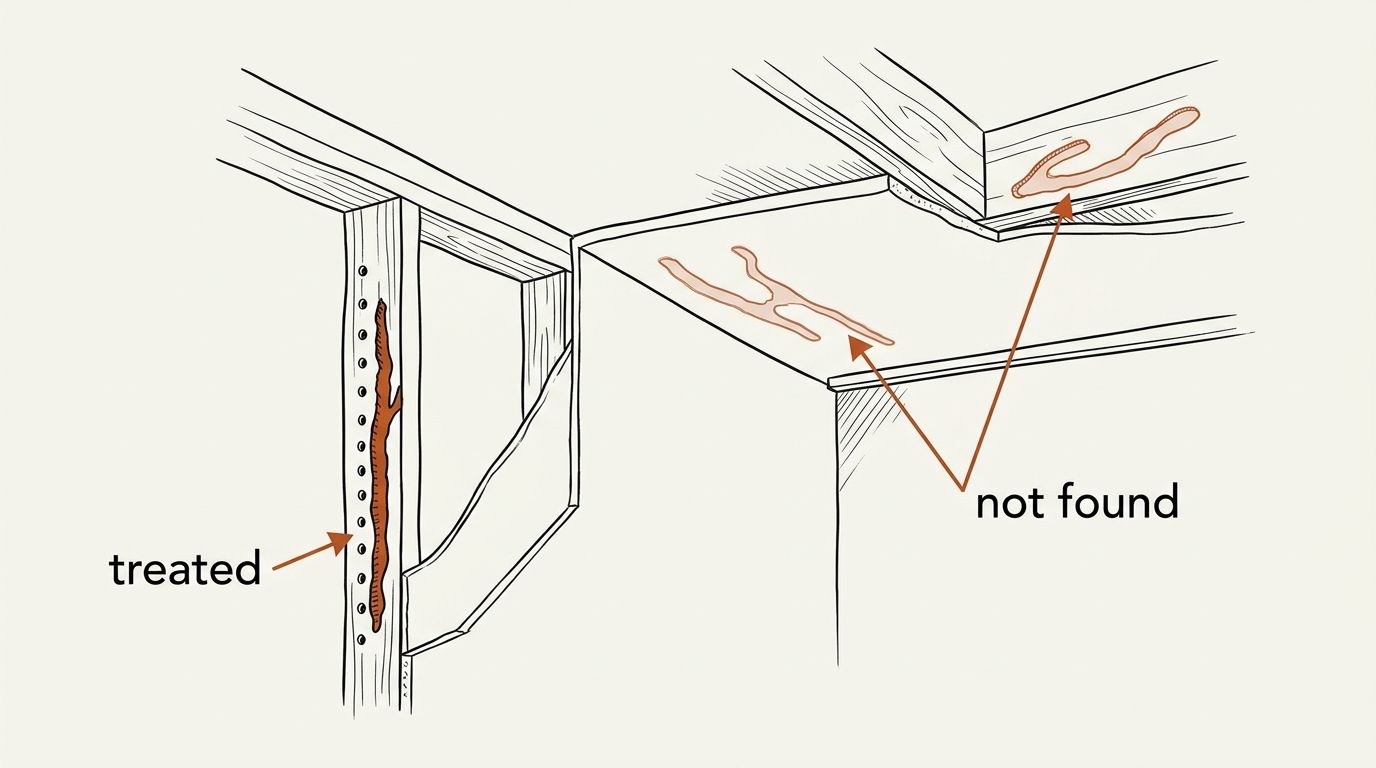
None of this says spot treatment never works. It says the chemical is rarely the limiting factor. Finding the termites is.
How long it lasts
Mostly it does not. Orange oil leaves no residue, and the Bio-Integral Resource Center’s assessment is that once the smell has gone, three to ten days depending on temperature, “it is likely that any insecticidal action also disappeared.” Its label bars reapplication to the same area within one year, which is worth knowing before you buy it as your first attempt.
Borate treatment of bare wood does persist, and that is its genuine advantage, though only where the wood stays clear of rain and ground contact.
Physical methods such as microwaves and electrocution leave nothing behind at all, by definition. A microwave or an electrogun kills what it reaches on the day and protects nothing afterwards.
When it is the right call
Accessible, exposed wood. That is the boundary, and the California field study’s own summary draws it: localized treatments are “best with exposed accessible boards and less when infestations are concealed or inaccessible.”
An infested piece of furniture is the cleanest case there is. A single visible attic rafter with one kick-out hole is a reasonable case. Early activity that somebody has actually instrument-located, rather than estimated, is a reasonable case.
The Hawaii researchers compressed the condition into one clause. Localized treatments “are appropriate for use when the extent of the drywood termite infestation can be accurately deliminated.”
When it is not, and what I would do instead
When you cannot say where the termites are. Pellet piles in unrelated parts of the house, or activity behind drywall, and you are buying a guess. UC IPM: “with the uncertainty of current detection methods, particularly when drywall or other wall coverings conceal infestations, there is always some doubt as to the extent of drywood termite colony boundaries and the number of colonies within homes. Consequently, one can never be sure all infestations have been treated when applying localized treatments.”
When you need the house cleared. California’s consumer fact sheet is the bluntest document in this whole subject, and anyone weighing a spot treatment should read this sentence before signing:
“These methods are intended to remove or kill termites only within the specific targeted area, leaving open the possibility of other undetected infestations within the structure. These treatments are NOT designed for whole-house eradication. Any pest control company that claims whole-house results with local or spot control methods is guilty of false advertising and should be reported.”
If someone sells you a spot treatment as a whole-house solution in California, that is not a difference of professional opinion. The state has written down what it is.
When the margin for error is thin. The California field study noted that as few as ten surviving termites can re-establish the same infestation, and that inaccessible areas may represent 40% of the structural members in a home. Those two facts sitting together are why I would not spot-treat a house with a long infestation history. There I would take whole-structure fumigation and treat the disruption as the price of knowing.
The alternative, fairly stated
Fumigation treats every infestation in the building at once, including the ones nobody found, and UC IPM notes that a monitored fumigation, with gas monitoring lines run inside the structure, “has the highest rate of treatment success.”
It is also disruptive, expensive, requires you to leave, and leaves no residual protection whatsoever. Nor is it flawless. The Bio-Integral Resource Center cites a 1964 Los Angeles study in which 26 to 37% of fumigated structures showed active infestation again within three to five years, and puts operator-reported callback rates for fumigation at 5 to 15%, the same band operators report for orange oil.
The choice is not between a reliable method and an unreliable one. It is between treating everything imperfectly and treating one thing well, and which is right depends entirely on how confident anyone can be about where the termites are.
What goes wrong
The colony nobody found keeps eating. Everything else on this list is a variation of that.
Detection equipment narrows the problem without ever quite solving it. The 2012 trial found its motion detector produced 9.5% false negatives under close to ideal conditions.
Results also vary a great deal according to which applicator happens to turn up. UC IPM again: “There also appears to be considerable variation in effectiveness of various techniques from applicator to applicator.”
Microwaves deserve a specific warning, because more power sounds like more certainty and is not. UC IPM reports that “lab studies revealed no relationship between increasing microwave wattage and drywood termite mortality,” and that heat sinks in a structure make some areas hard to bring up to temperature at all.
Drilling for injection also leaves holes in your woodwork. Small, but real, and worth agreeing on in advance.
What to ask before you sign
- “How did you determine the extent of this infestation? Visual inspection, or detection equipment?”
- “Which specific boards are you treating, and what did you find in each one?”
- “What share of this structure could you not inspect?”
- “If activity shows up somewhere else in six months, is that covered?”
- “Does this product leave residual protection, or is it a one-time kill?”
- “Are you telling me this clears the whole house?” In California that answer has a legal edge on it.
- “What would change your recommendation from spot treatment to fumigation?”
Here’s what I’d actually do
If the infestation were one accessible board or a piece of furniture, I would spot-treat it and not think about it again.
If there were pellets in two unconnected parts of the house, I would stop and pay for a second inspection before spending anything on treatment. At that point I am not buying a treatment, I am buying somebody’s confidence about what they cannot see, and that is worth checking twice.
And I would ask every bidder the third question above. The honest answer, which nobody volunteers, is that a substantial share of any house cannot be inspected. A contractor who says so up front is more trustworthy than one who quotes a spot job with total certainty.
Sources
- Pest Notes: Drywood Termites (Publication 7440) — V. R. Lewis, A. M. Sutherland and M. I. H. Haverty, UC Statewide IPM Program, updated August 2014. Accessed 2026-08-04.
- Field Evaluations of Localized Treatments for Control of Drywood Termite Infestations in California — Vernard Lewis, Sara Moore, Robin Tabuchi and Gail Getty, University of California Berkeley, for the California Structural Pest Control Board. Final report, 2009. Accessed 2026-08-04.
- Evaluation of Chemical Localized Treatment for Drywood Termite Control — Michael K. Rust and Jody Venturina, UC Riverside, for the California Structural Pest Control Board. Final report, 2009. Laboratory study. Accessed 2026-08-04.
- Structural Pest Control Fact Sheet: Exterminating Termites — California Structural Pest Control Board, Department of Consumer Affairs, July 1998. Still posted by the Board; the contact details printed on it are out of date. Accessed 2026-08-04.
- Hickman, R. and Forschler, B. T. (2012). Evaluation of a localized treatment technique using three ready-to-use products against the drywood termite Incisitermes snyderi in naturally infested lumber. Insects 3(1): 25–40, published 2012-01-03. Full text. The lead author was employed by BASF. Accessed 2026-08-04.
- Woodrow, R. J. and Grace, J. K. (2007). Efficacy of localized chemical treatments for Cryptotermes brevis in naturally infested lumber. Proceedings of the Hawaiian Entomological Society 39: 149–152, University of Hawaii at Manoa. PDF. Accessed 2026-08-04.
- Pesticide product label, Bora-Care, EPA Reg. No. 64405-1 — Nisus Corporation, EPA notification accepted 2023-08-04. Accessed 2026-08-04.
- Pesticide product label, XT-2000 Orange Oil Plus, EPA Reg. No. 71986-2 — XT-2000 Inc., EPA amendment accepted 2015-02-19. Accessed 2026-08-04.
- Mashek, B. and Quarles, W. (2008). Orange oil for drywood termites: magic or marketing madness? IPM Practitioner XXX(1/2), January/February 2008, pages 1–9. Bio-Integral Resource Center. The lead author owns a California termite control company. Accessed 2026-08-04.
Where it works well
- Far less disruptive than tenting. Nobody leaves the house and no food gets bagged.
- Reasonable when the infested wood is accessible and exposed, which is where the evidence is strongest.
- Cheaper than whole-structure fumigation, and the most popular alternative to it.
- Wood replacement is an option here that no chemical method offers.
Where it falls short
- It only treats what was found, and drywood colonies are small, hidden and easily missed.
- California's pest control board says outright that it cannot eradicate a whole house.
- Published field results are weak, and effectiveness varies considerably between applicators.
- Most methods leave no residual, so nothing protects the wood afterwards.
Common questions
The pellets stopped after treatment. Does that mean it worked?
Not on its own. UC IPM notes it is not possible to determine from pellets alone whether an infestation is active, or how far it extends through the wood. Cleaning up a pile and checking for fresh pellets days later is a decent test of activity at that spot, and no test at all of galleries elsewhere in the structure that never had a kick-out hole above your floor.
Is orange oil a real treatment or marketing?
It is a registered pesticide, d-limonene, and it kills termites it contacts. What it lacks is published field efficacy. UC IPM says recent lab and field tests from two universities question d-limonene's efficacy, and the Bio-Integral Resource Center reported in 2008 that no field studies had been published at all. Its own label bars reapplication to the same area within a year.
Can I do a spot treatment myself with a borate product?
Borate products such as Bora-Care are not federally restricted-use, so buying one is generally possible. Whether you should is a different question. UC IPM states that the products needed to control drywood termites are not available to the general public, and that localized treatments should be applied only by licensed applicators. The label also defers to state rules, and several states are stricter than the label.