 Termite Registry
Termite Inspection
A termite inspection is a visual and probing examination of the parts of your house someone can actually reach. That qualifier is the whole subject, and it is narrower than almost anyone expects.
The industry’s own standard form, the NPMA-33 used for FHA and VA loans, says crawl spaces and attics “may be deemed inaccessible if the opening to the area is not large enough to provide physical access for the inspector or if a ladder was required for access.” A crawlspace with under 24 inches of clearance below the floor joists also qualifies.
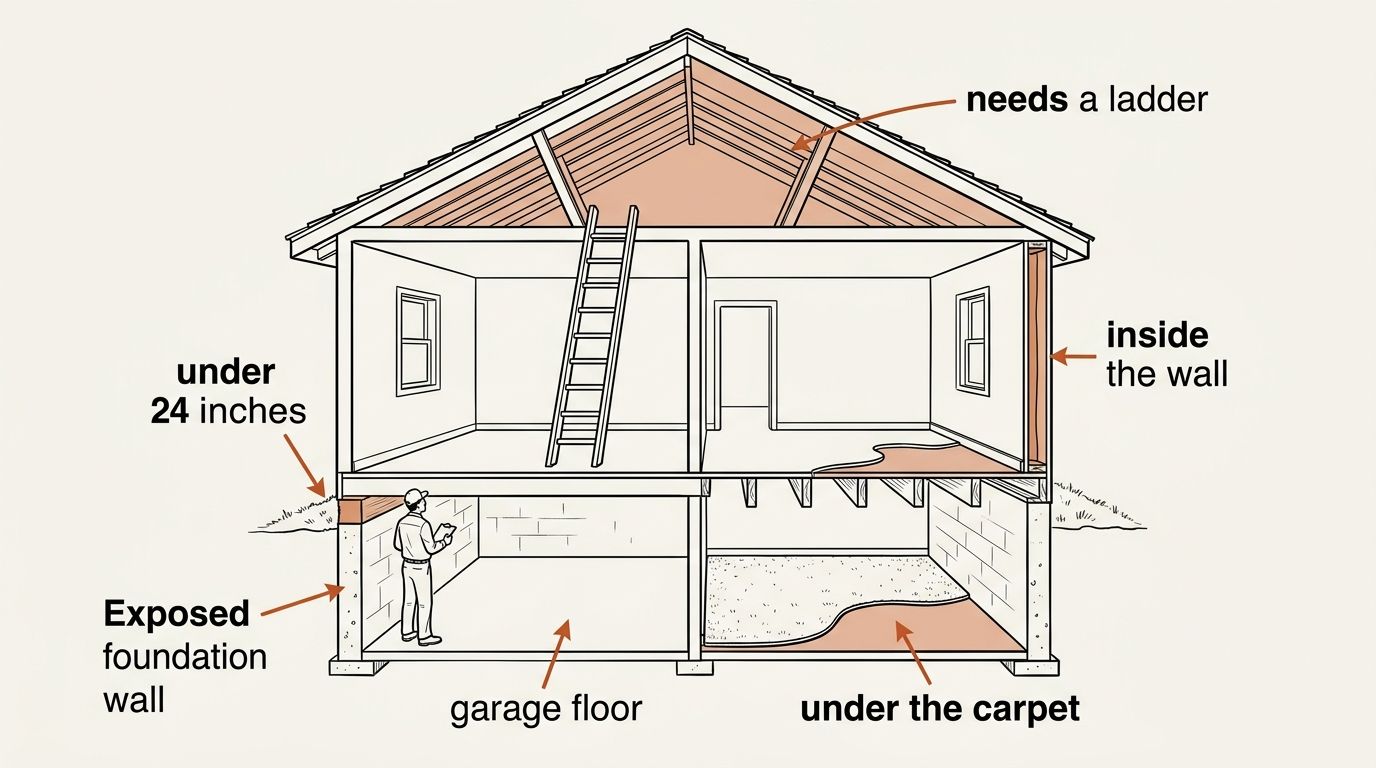
So a clean report can mean the attic was never entered. That is not misconduct, it is the printed scope.
What it costs
There are several ways this turns out to be free, and they are worth checking before you book anything.
If you hold a termite contract, the annual inspection is usually part of the renewal fee you are already paying. Mississippi State Extension: keep the contract in force “and the company will conduct an annual termite inspection for no additional charge.”
If two companies disagree with each other, your state may inspect for nothing. North Carolina’s Department of Agriculture is unambiguous: “There is not a fee for an inspection by the Structural Pest Control Division. All inspections are conducted as a consumer service.” Georgia lists “a conflicting report between two pest control companies such as pest identification or activity” as a qualifying reason to request one. Almost nobody knows this option exists.
Price is not the thing the states regulate. California, for one, sets a $5 filing fee the company owes the board for each property, and says nothing about what the company charges you.
What the inspector actually does
Probing and sounding, mostly, with a flashlight. The NPMA-33 describes its own method as “probing and/or sounding of unobstructed and accessible areas.”
EPA suggests you do the same thing yourself before calling anyone. Its termite page lists, as a way to find out whether you have them: “Examine, by probing, exposed wood for hollow spots (using a flathead screwdriver or similar tool).” NC State adds the caveat that this test is “not entirely accurate,” which is fair, and UC IPM notes that damaged wood “is typically thin at the surface and easily punctured with a knife or screwdriver.”
Mud tubes get broken open to check for live workers. Kentucky’s extension service adds the limit of that test: “If a tube happens to be vacant, it does not necessarily mean that the infestation is inactive; termites often abandon sections of tube while foraging elsewhere.”
Moisture readings need a meter, and more than one of them. NC State: “Wood moisture content can only be determined using a moisture meter. Make sure that enough readings are collected so as to be truly representative of the area of concern.”
As for dogs, acoustic detectors and borescopes, UC IPM’s assessment is deflating: those methods “are infrequently used. Visual inspection by inspectors for evidence of termites and damage remain the mainstay of the industry.” A company marketing detection technology is selling something Tier 1 sources describe as rare, without publishing a reliability advantage.
What the report should contain
California’s structural pest control law is the most specific published standard, and it is a useful yardstick even if you live elsewhere. A report there must carry a foundation diagram or sketch showing the approximate location of infested areas, naming the members in standard construction terms: siding, studs, rafters, floor joists, fascia, subfloor, sheathing, trim boards.
It must also state conducive conditions separately from termites — earth-wood contacts, faulty grade levels, excessive moisture, roof leaks, insufficient ventilation — and it must describe any area that was not inspected and why, with a supplemental report if that area is later opened up.
Two things worth noting about the standard form. Neither NPMA-33 nor California’s statute requires the report to name a species, only to describe and locate the evidence. And the form disclaims the inspector’s competence to judge damage: “The inspector’s training and experience do not qualify the inspector in damage evaluation or any other building construction technology and/or repair.” People routinely treat a termite inspector’s damage note as a structural verdict. The form says it is not one.
When you need one, and when you do not
Swarmers appearing indoors is the clearest trigger there is, and the sources are unanimous on it. Kentucky: “Discovering winged termites indoors almost always indicates an infestation warranting treatment.” Mud tubes, pellet piles, and a purchase or refinance are the others.
Swarmers in the yard are not a trigger. Termites emerging from a stump or woodpile are doing what they should be doing, and Kentucky notes it does not automatically mean the house is infested. If they are coming out next to the foundation or from an abutting porch, that is different.
Before paying anyone for an opinion, you can often get one free. NC State points homeowners to their county extension center with a sample, and Mississippi State runs an insect identification service by post. If you cannot tell an ant from a termite, that is a free answer, and the Termite Scan walkthrough here covers the same ground.
A purchase or refinance is the one trigger on that list that changes what you are buying. What a lender wants is a specific document on a specific form, issued by someone holding a licence whose number goes on it, and ordering that is a different engagement from this one: my page on the WDI inspection report covers who may issue it, which form arrives, and what to specify before the visit.
What a clean report cannot tell you
That your house is free of termites. Mississippi State Extension states it as plainly as anyone:
“all the inspection can tell you is that a trained technician conducted a professional inspection of the building and did not find any termites. Because of the potential for hidden termite infestations, this should not be viewed as a guarantee the building is free of termites.”
Kentucky adds why even a good inspector misses things: infestations “can go undetected for years, hidden behind walls, floor coverings, insulation, and other obstructions,” and “even the most experienced inspector can overlook signs that are hidden.”
The NPMA-33 itself carries the same disclaimer, and a 90-day expiry: the report “shall be considered invalid for purposes of securing a mortgage and/or settlement of property transfer if not used within ninety (90) days from the date of inspection.”
Who the inspector works for
The person inspecting your house usually works for the company that would sell you the treatment. That is not a scandal and plenty of them are straight with you. It is still worth knowing who pays them, and the government sources say so too.
NC State Extension tells homeowners to ask about the pay structure directly:
“You should feel free to ask if the individual assessing your pest problem is a technician or a salesperson for the company, or if they are a salaried employee or are paid partially on a commission basis. This does not imply that salaried employees are more truthful or more accurate than those working on a commission basis. Asking questions simply shows that you expect to be treated professionally.”
EPA tells you not to take the seller’s word about the seller: “Don’t rely on the company salesperson to answer this question. Research the answer yourself.” And Kentucky frames multiple bids as verification rather than price-shopping: requesting inspections from more than one company “will help verify the existence of a termite infestation.”
The form itself is worth reading closely on this. The NPMA-33 requires the inspector to declare that neither they nor the company “has had, presently has, or contemplates having any interest in the property inspected.” It says nothing about an interest in the treatment contract. So the declaration covers buying your house, which nobody was worried about, and not selling you a treatment, which is the actual question.
What goes wrong
Being rushed. Every source I read warns about it, which is unusual unanimity. Texas A&M: “Delaying a few weeks makes no difference.” Kentucky: “Avoid firms that try to pressure you into signing a contract immediately with specials or scare tactics.” NC State points out you have three days to cancel a North Carolina termite contract, and that “a delay of even several weeks is really of no real consequence in terms of additional termite damage.”
Misidentification is the next most common way this goes wrong, and it runs in several directions. Ants get read as termites, carpenter ants and powderpost beetles get read as termites, and moisture damage gets read as termite damage. The flying ants comparison covers the first of those.
Then there is old damage sold as new. NC State: “It is difficult (nearly impossible) to determine the age of termite damage simply by looking at the wood. Claims that an infestation is active must be supported by visible evidence. Don’t accept a conclusion of ‘suspected’ termite activity.”
And the same publication’s rule for the whole transaction: “Do not accept costly services without proof that you have a problem.” The company should be able to show you a live specimen from your building before treating.
Checking the license
Inspection is itself a licensed act, not just treatment. California law bars a company from issuing any document stating the presence or absence of wood-destroying organisms until a licensed field representative has inspected. In North Carolina the wood-destroying category is a separate license phase, so a company licensed for household pests “cannot perform any treatments for termites or other wood-destroying pests.”
Every state runs a public lookup and it takes about ninety seconds. California’s is at search.dca.ca.gov, Georgia’s at agr.georgia.gov/licensing, and Texas runs a pesticide license search.
What to ask
- “Is your company licensed for wood-destroying pests specifically, and what is the number?”
- “Is the person coming out a technician or a salesperson, and are they paid on commission?”
- “Which areas will you not inspect, and what would it take to make them accessible?”
- “Will the report include a diagram and list the areas you skipped?”
- “Show me the live specimen, or the visible evidence.”
- “Is this activity live or old, and what tells you that?”
- “Did you use a moisture meter, and where did you take readings?”
- “What conducive conditions did you find, separately from termites?”
- “Is this a firm price, itemised per recommendation?”
Here’s what I’d actually do
I would ask question 3 before booking rather than after, because the answer shapes what the report is worth. An inspector who tells you up front that the attic needs a ladder and therefore counts as inaccessible is being straight with you, and one who implies total coverage is not.
I would walk the outside myself before the appointment, using the printable inspection checklist. It costs an hour and it changes the visit: anything you can already point at gets looked at properly, and you find out in advance which areas are blocked by stored boxes or a locked hatch.
I would never authorise a four-figure treatment on the strength of one visit. Getting a second inspection is what the extension services recommend, it is cheap or free, and it is the single highest-value thing you can do at this stage.
And if two companies come back saying different things, I would call the state before calling a third company. In several states an inspector will come out for nothing, and their opinion is the only one on the list with no treatment to sell.
Sources
- Form NPMA-33, Wood Destroying Insect Inspection Report — National Pest Management Association, form dated 2019-07-01, hosted by the US Department of Housing and Urban Development. Accessed 2026-08-04.
- Termites: How to Identify and Control Them — US Environmental Protection Agency, last updated 2025-10-21. Accessed 2026-08-04.
- Citizen’s Guide to Pest Control and Pesticide Safety — US Environmental Protection Agency, EPA 735-K-04-002, March 2005. Accessed 2026-08-04.
- Tips on Selecting Pest Control Services — NC State Extension, published 2017-12-26, reviewed and revised 2023-01-29. Accessed 2026-08-04.
- Structural Pest Control Act and Rules and Regulations — California Structural Pest Control Board, updated as of July 2025. Business & Professions Code §8516 and 16 CCR §1990. Accessed 2026-08-04.
- Termite Control: Answers for Homeowners (ENTFACT-604) — Michael F. Potter, University of Kentucky Department of Entomology, revised March 2026. Accessed 2026-08-04.
- Pest Notes: Drywood Termites (Publication 7440) — UC Statewide IPM Program, updated August 2014. Accessed 2026-08-04.
- How to Select a Termite Control Service (E-369) — Gold, Merchant, Howell and Glenn, Texas Cooperative Extension, December 2005. Accessed 2026-08-04.
- Common Questions about Termites and Termite Control — Blake Layton, Mississippi State University Extension Service. The page carries no printed publication or revision date. Accessed 2026-08-04.
- Structural Pest Control Investigation & Complaint Response Guide — North Carolina Department of Agriculture & Consumer Services. No printed date on the page. Accessed 2026-08-04.
- Structural Pest Consumer Information — Georgia Department of Agriculture. No printed date on the page. Accessed 2026-08-04.
Where it works well
- Establishes what you actually have before any money is spent on treatment.
- Produces a written record with a diagram you can use to compare bids.
- Often included in a treatment contract you are already paying for.
- State regulators will inspect free when two companies disagree.
Where it falls short
- Covers accessible areas only, and the standard form lets a ladder make an attic inaccessible.
- A clean report is not evidence the building is termite-free.
- The person inspecting often works for the company that would sell the treatment.
- The inspector is not qualified to assess the structural damage they find.
Common questions
Is a free inspection worth having?
Usually, as long as you treat it as one opinion. The thing to know is that the standard NPMA-33 form requires the inspector to declare no interest in the property, and says nothing at all about an interest in the treatment contract the same company may then sell you. Ask whether the person is a technician or a salesperson, and whether they are paid on commission. NC State Extension recommends asking exactly that.
The report came back clean. Is my house termite-free?
No, and Mississippi State Extension says so directly: all the inspection tells you is that a trained technician inspected and did not find termites, which because of hidden infestations should not be viewed as a guarantee the building is free of them. Termites can go undetected for years behind walls, floor coverings and insulation, and damage progresses in exposed wood because the outer surface stays intact.
How often should I get one?
The official sources disagree, which is worth knowing before you buy an annual plan. UC IPM says every three to five years, and every several years for homes with a history of infestation. North Carolina's agriculture department recommends thorough annual inspections. If you hold a termite contract, the annual inspection is usually already included in the renewal fee you pay.