 Termite Registry
identification
What Do Termites Look Like? A Field Key
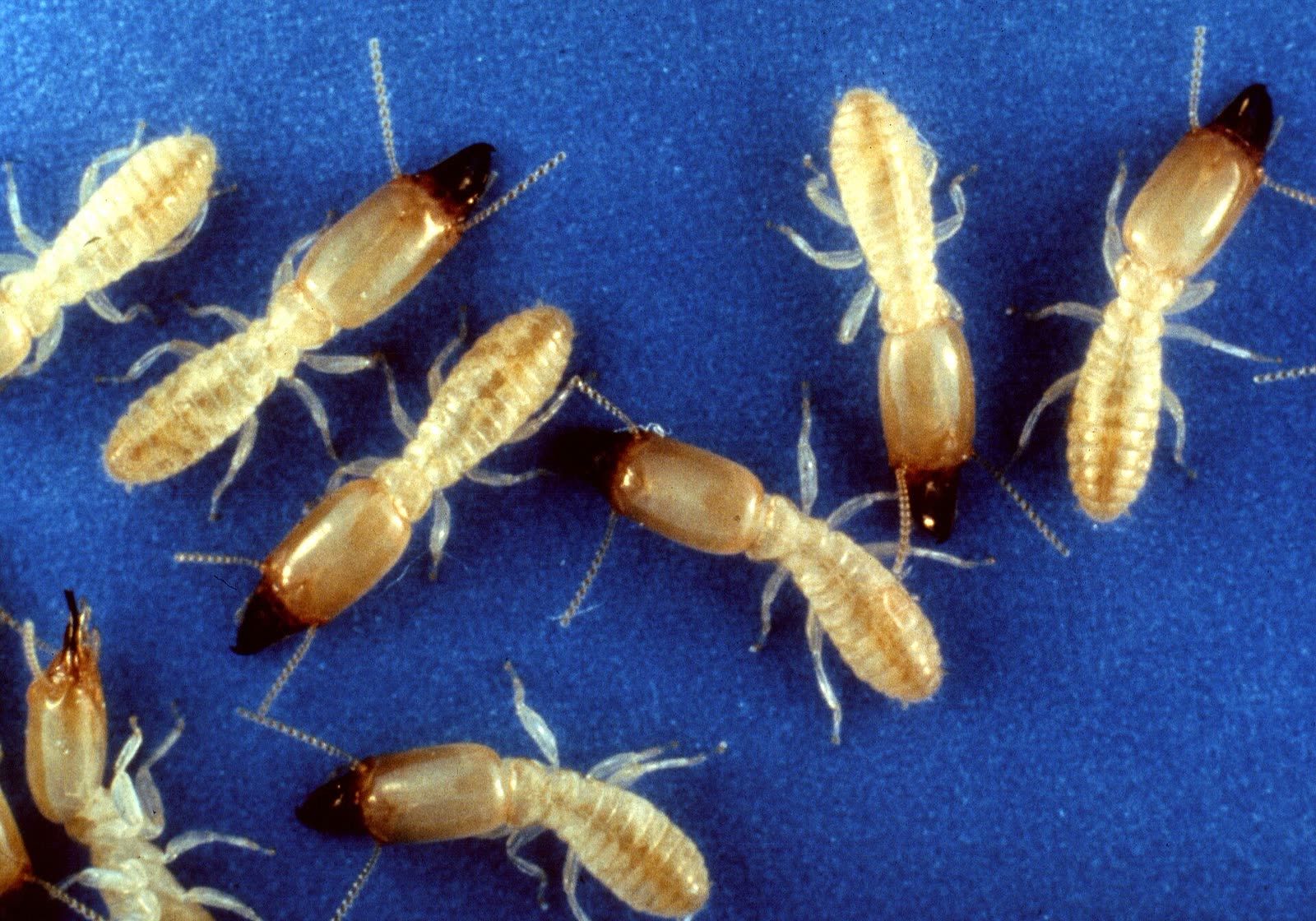

Most termites are small, soft, pale, wingless workers with straight antennae and no pinched waist; the ones people actually see are the dark winged swarmers, and soldiers look like workers with a large, hard, dark head. Identifying the specific insect you found comes down to its physical caste, its body shape, and whether it has wings.
What does a termite look like?
A termite’s appearance depends entirely on its role in the colony. Most of the population consists of pale, blind workers, while the defensive soldiers carry enlarged heads, and the reproductive swarmers feature dark bodies with long wings.
| Caste | Color | Body | Wings | Where you see it |
|---|---|---|---|---|
| Worker | Creamy white to pale tan | Soft, about 1/8 inch, no eyes | No wings | Inside wood, soil, or a broken mud tube |
| Soldier | Pale body with a large, hard, amber to dark brown head | Slightly larger than a worker, heavy jaws | No wings | Next to workers when the colony is disturbed |
| Swarmer | Dark brown to black for subterranean, lighter for others | Firmer body with eyes, about 3/8 to 1/2 inch long | Four wings of equal length extending past body | At windows, light fixtures, or shed wings on sills |
| Queen | Pale to dark brown | Much larger reproductive with a swollen abdomen | No wings once established | Inside the deep nest, almost never seen |
What do worker termites look like?
Worker termites are small, wingless insects with soft, pale bodies, straight antennae, and broad waists. They look similar to translucent, white ants, but they lack the narrow waist joint that defines all ant species.
These pale workers are the insects many people call white ants, and they are not ants at all.
Young termites hatch looking like tiny pale workers; my page on termite larvae covers them and the grubs people mistake for them.
UC Statewide IPM Program describes workers as wingless, soft-bodied, and light caramel in color, making up the largest group in most colonies and representing the individuals most frequently seen when infested wood is examined. University of Kentucky’s entomology department describes breaking a mud tube open to check for small, creamy-white workers. UF/IFAS Extension notes that workers find and digest food, maintain the nest, and care for the brood, while soldiers defend the colony.
Notice that two university sources use two different color descriptions for the exact same insect. One calls them light caramel while the other calls them creamy-white. Either way, the worker is pale. Depending on what wood they have been eating and the moisture levels in the cavity, workers range from a milky off-white to a light tan. Because they live their entire lives inside darkness, they never develop dark pigmentation or compound eyes.
You will almost never see a worker termite crawling across your living room floor in open light. Because their skin is soft and thin, exposure to open dry air dehydrates them rapidly. You will only encounter workers if you open up infested structural timber, crack open hollow trim, or break open a protective shelter channel running up a foundation wall.
What do termite soldiers look like?
Termite soldiers look like workers with dramatically oversized, hardened heads armed with visible jaws. Their torsos remain soft, pale, and wingless, but their broad heads range from bright amber to deep reddish-brown.
If you are asking do termites bite, the soldier is the one that can: its jaws pinch a finger that picks it up, with no venom.
Different termite species carry distinct soldier head shapes:
- Subterranean soldiers: These feature a long, rectangular, yellow-brown head with dark, curved jaws projecting forward.
- Formosan soldiers: These carry an oval, teardrop-shaped, orange-brown head and can release a small drop of white sticky fluid from a pore on the head when disturbed.
- Drywood soldiers: These have a large, dark reddish-brown head that looks flattened or squared off, equipped with heavy, jagged jaws.
UC Statewide IPM Program notes that if you break termite tubes open, you may see live workers and soldiers running through them together. While workers retreat deeper into the structural wood when exposed, soldiers move toward the breach, snapping their jaws outward to protect the breach against invading ants. They make up a small percentage of the total colony, so finding several dark-headed insects among a cluster of soft white bodies is a strong indicator of an active nest.
What do flying termites look like?
Flying termites, or swarmers, are dark, sleek insects with two pairs of long, equal-sized wings that fold flat over their back. Unlike pale workers, swarmers feature hard, pigmented bodies built to withstand open air and sunlight during their brief mating flight.
UF/IFAS Extension explains that nymphs are produced seasonally to become alates, which are winged adults that fly away from the parental nest to establish new colonies. They add that after indoor flights, most alates are found dead near windows or in sinks and bathtubs, usually with their wings still attached. Texas A&M Extension advises homeowners to search for termite bodies and wings in light fixtures, cobwebs, and on window sills.
UC Statewide IPM Program notes that drywood swarmers fly during daytime hours in summer and fall, while dampwood swarmers can be differentiated by their larger overall size and their attraction to lights at dark. University of Kentucky Extension emphasizes that termite swarmers emerging indoors are incapable of damaging wood and live for only about a day.
When swarmers land, they drop their wings quickly by snapping them off at built-in stress lines near the shoulders. If you find small dark insects crawling without wings alongside tiny piles of translucent wings, that is consistent with swarmers that have already dropped their wings. To learn how to identify these dropped appendages, read my guide on termite wings.
Do all termites have wings?
No, most termites never develop wings. Only the reproductive caste, known as swarmers or alates, grows wings, and they wear them only for the short duration of their dispersal flight.
Workers and soldiers spend their entire lifecycles wingless, performing their duties inside dark galleries and mud tunnels. Even the winged swarmers shed their wings immediately after landing to pair off and search for a damp wood cavity or soil entry point. UF/IFAS Extension notes that the queen lays eggs that can develop into various castes, depending on the specific needs of the growing colony. You can learn more about how colony development begins in my breakdown of termite eggs.
Once a male and female pair off, drop their wings, and excavate a starter chamber, they become the king and queen. The queen’s body stretches over time to accommodate massive egg production, leaving her completely flightless for the rest of her multi-year life.
The termite queen has her own page: where she lives by species and what happens when she dies.
How do subterranean, drywood, and Formosan termites look different?
The three main structural termite groups in North America differ in body color, head shape, and swarming schedules. Subterranean swarmers tend to be dark brown or black, while drywood and Formosan swarmers feature lighter, reddish or golden-yellow tones.
| Group | Swarmer | Soldier head | When swarmers fly | Read next |
|---|---|---|---|---|
| Subterranean | Small (about 3/8 inch), dark brown to black | Long, rectangular, yellow-brown | Day, mostly spring after rain | Subterranean termites |
| Drywood | Medium (about 1/2 inch), amber to reddish-brown | Large, dark reddish-brown with heavy teeth | Summer and fall in daytime | Drywood termites |
| Formosan | Medium (about 1/2 inch), yellow-brown and hairy | Oval, teardrop-shaped, orange-brown | Dusk or night, attracted to lights | Formosan termites |
While seeing the physical insect gives you immediate clues, the surrounding nest evidence provides equal clarity. My comparison of subterranean vs drywood termites settles which group you are dealing with based on whether you find soil-based mud tubes or dry fecal pellets. Seasonal flight windows also vary significantly by geographic region, which I detail in my guide to termite swarm season.
What looks like a termite but is not?
Winged ants are the most common insect mistaken for flying termites because both swarm outdoors around the same time of year. True termites carry straight antennae, broad waists, and equal-length wings, whereas ants carry jointed antennae, pinched waists, and unequal wings.
University of Kentucky Extension outlines the distinction directly: “Termites have straight antennae, a uniformly thickened waist, and wings of equal size. Conversely, ants have elbowed antennae, constricted waists, and forewings that are longer than the hind wings.”
To inspect an insect yourself, focus on these three key features:
- Antennae: Termite antennae look like tiny strings of straight beads. Ant antennae feature a sharp wrist-like elbow joint in the middle.
- Waistline: A termite has a continuous, tubular body with no narrow pinch points. An ant features an hourglass waist with a distinct, pinched thread connecting the chest and abdomen.
- Wing Length: A flying termite carries four wings that are about the same size and shape. A flying ant carries large front wings paired with noticeably smaller hind wings.
If you are dealing with a flying insect and want to double-check these features step by step, use my complete flying ants vs termites key. Large black ants in damp or damaged wood raise a different question, and my guide on carpenter ants vs termites covers it.
What should I do if I think I found a termite?
If you find a suspect insect, secure a physical sample in a container, take clear photographs of the area, and arrange for a professional inspection. You do not need to panic or sign a high-pressure contract on the spot.
University of Kentucky Extension emphasizes that termites damage wood slowly, noting that the amount of damage caused by taking an additional day, week, or month to make an informed decision is generally inconsequential.
Here is the exact practical sequence to follow:
- Capture a sample: Collect one or two intact insects using a damp paper towel and place them inside a sealed plastic bag or small glass jar. If you only see dropped wings, collect several wings on a piece of clear tape.
- Document the location: Take photos of the exact spot where the insects emerged, as well as any light fixtures or window sills where dead swarmers collected.
- Inspect the surroundings gently: Check nearby baseboards, crawlspace entry points, and exterior foundation walls for secondary indicators. Look for mud channels or gritty fecal pellets without pulling off trim or opening drywall. You can check your property against the full list of signs of termites.
- Schedule an evaluation: Reach out to a licensed professional to schedule an on-site termite inspection.
If you are still looking at an unidentified bug on your floor and cannot tell if it fits these descriptions, run through my interactive termite scan to clarify what you are seeing.
What I would do if I found a suspect bug in my house
If I spotted a strange bug near a window or found a soft spot in wood trim, I would capture two or three specimens in a glass jar, store them in rubbing alcohol to preserve their shape, and carefully examine their waists and antennae under a bright light. I have not seen your house, but a few days spent getting the identification right costs the wood very little.
I would photograph any soil tubes on the foundation or wings on the window sills, leave the surrounding structural wood completely intact so the colony remains undisturbed, and book an inspection rather than a treatment. Booking a thorough termite inspection gives you an objective assessment of whether an active colony exists, where it is located, and exactly what treatment method matches your home’s layout.
Sources
- Pest Notes: Subterranean and Other Termites (Publication 7415) — UC Statewide IPM Program, 2014-05. Accessed 2026-10-05.
- Termite Control: Answers for Homeowners (ENTFACT-604) — University of Kentucky Department of Entomology — Michael F. Potter, 2026-03. Accessed 2026-10-05.
- Native Subterranean Termites: Reticulitermes flavipes, R. virginicus, R. hageni (EENY-212) — University of Florida IFAS Extension, Featured Creatures, undated. Accessed 2026-10-05.
- Pest Notes: Drywood Termites (Publication 7440) — UC Statewide IPM Program, 2014. Accessed 2026-10-05.
- Drywood Termites (E-366) — Texas Cooperative Extension — Roger E. Gold, Harry N. Howell Jr., Grady J. Glenn and Kimberly M. Brown, 2005-12. Accessed 2026-10-05.
Common questions
Are termites white?
The workers are, more or less: creamy white to pale tan, and soft enough to look almost see-through. They are most of the colony, but they stay inside wood, soil, and mud tubes. The termites people usually see are swarmers, which are darker, often dark brown to black, with wings.
Can you see termites with the naked eye?
Yes. A worker is about an eighth of an inch long and a swarmer with its wings is larger, so both are visible without a lens. The problem is not size but where they live. Workers almost never come out into the open, which is why a broken mud tube or a pile of shed wings is the usual first sighting.
- what do termites look like
- identification
- castes
- swarmers
Related reading
identification
Flying Ants vs Termite Swarmers: How to Tell
A swarmer is a winged termite or ant that left its colony to breed, and a pile of them on a windowsill is what most people find first.
identification
Signs of Termites in the House: What Each Means
A sign of termites is a physical trace the insects left behind, not the insects themselves. Every sign below is worth acting on, and the two you are most likely to find, a mud tube and a pile of…
identification
Termite Wings: What Shed Wings Mean
Termite wings are shed by winged reproductives, called swarmers, which fly from a mature colony, drop their wings, and attempt to start a new one.