 Termite Registry
real-estate
What a WDI Report (NPMA-33) Means, Line by Line
Form NPMA-33 is the wood destroying insect report your lender asked for, the WDI report on your paperwork, and it records the visible evidence one inspector could reach on one day. A checked box does not mean live termites, and the form never certifies that a house is structurally sound.
You do not need to sign a treatment contract tonight. There is time to read both pages, ask the seller for treatment records, and get a second quote before any of this is due.
By the end of this you will know what your own copy establishes, how much of the house it left out, and whose rule the ninety days actually is.
Does a checked box on a WDI report mean live termites?
Box B in Section II means visible evidence was found. It does not mean live insects were in the structure on the day of the inspection.
Section II offers two options. Box A reads “No visible evidence of wood destroying insects was observed.” Box B reads “Visible evidence of wood destroying insects was observed as follows:” and is a single checkbox followed by three separately numbered lines, each with its own space for a description and a location:
- Line 1, “Live insects (description and location)”.
- Line 2, “Dead insects, insect parts, frass, shelter tubes, exit holes, or staining”.
- Line 3, “Visible damage from wood destroying insects”.
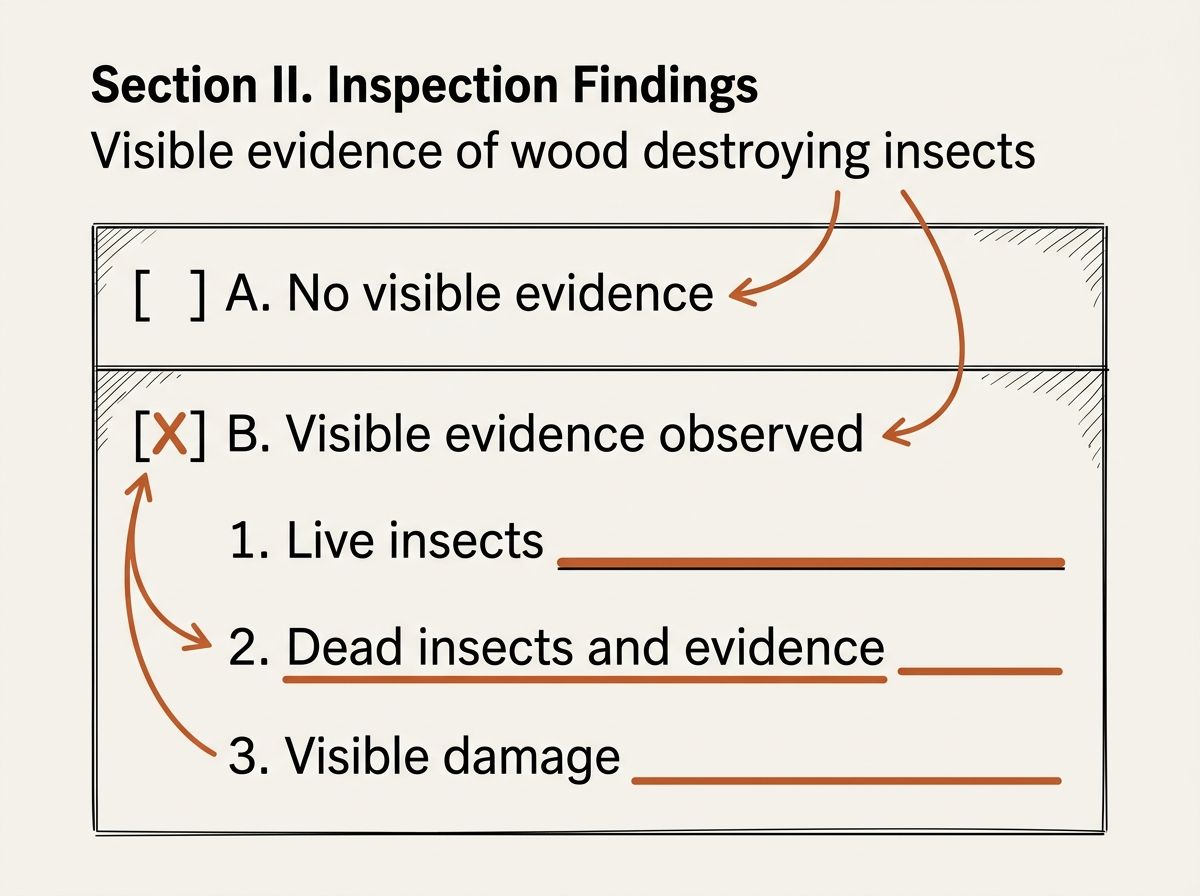
That distinction is where most of the fear in this category comes from. Line 2 is traces: frass, which is insect droppings, or shelter tubes, the mud tunnels termites build to cross exposed surfaces on their way into wood. You can see what those look like on my page about subterranean termites. Line 3 is damage, a record of something that happened at some point rather than something happening now.
Neither says anything about whether the building is sound. The form prints this immediately under those lines: “NOTE: This is not a structural damage report. If box B above is checked, it should be understood that some degree of damage, including hidden damage, may be present.” The person who checked the box is not the person qualified to price the repair, and page 2 says so: “The inspector’s training and experience do not qualify the inspector in damage evaluation or any other building construction technology and/or repair.”
What does the NPMA-33 form cover, and what does it exclude?
Four insects, seen with the eye, in the parts of the house the inspector could get to.
Buyers call this document a termite letter. Pest control operators and lenders call it a wood destroying insect report, and the document itself is titled “Wood Destroying Insect Inspection Report”, published by the National Pest Management Association, current edition dated 7/01/19.
Page 2 sets the scope: “For purposes of this inspection, wood destroying insects include: termites, carpenter ants, carpenter bees, and reinfesting wood boring beetles. This inspection does not include mold, mildew or noninsect wood destroying organisms.”
Wood rot is not on this form, and nothing about a completed one announces that. If decay is what worries you, this is not the document that answers it. The form also separates the inspection from any work: the firm “is not responsible to repair any damage or treat any infestation at the structure(s) inspected, except as may be provided by separate contract.” Where the report sits in the rest of a purchase is in my guide to termite inspection for home buyers.
How much of the house did the inspector actually look at?
Only what was unobstructed and reachable on the day, which on a furnished house can be a good deal less than the whole of it.
Section IV is where that gets recorded. It carries checkboxes for the basement, crawlspace, main level, attic, garage, exterior, porch, addition and other, plus a preprinted key of 26 numbered obstructions the inspector can point at instead of writing one out. Several of them describe an ordinary lived-in house: insulation, stored items, furnishings, appliances, cluttered condition.
Nobody moved your furniture and nobody pulled up flooring. Page 2 is explicit that no inspection was made in areas which required “the breaking apart or into, dismantling, removal of any object”.
Two limits decide whether the most termite-prone parts of a house were seen at all. An attic or crawl space may be deemed inaccessible if the opening is not large enough for the inspector to physically get through, or if a ladder was required. And crawl spaces, in whole or in part, may also be deemed inaccessible “if there is less than 24 inches of clearance from the bottom of the floor joists to the surface below.”
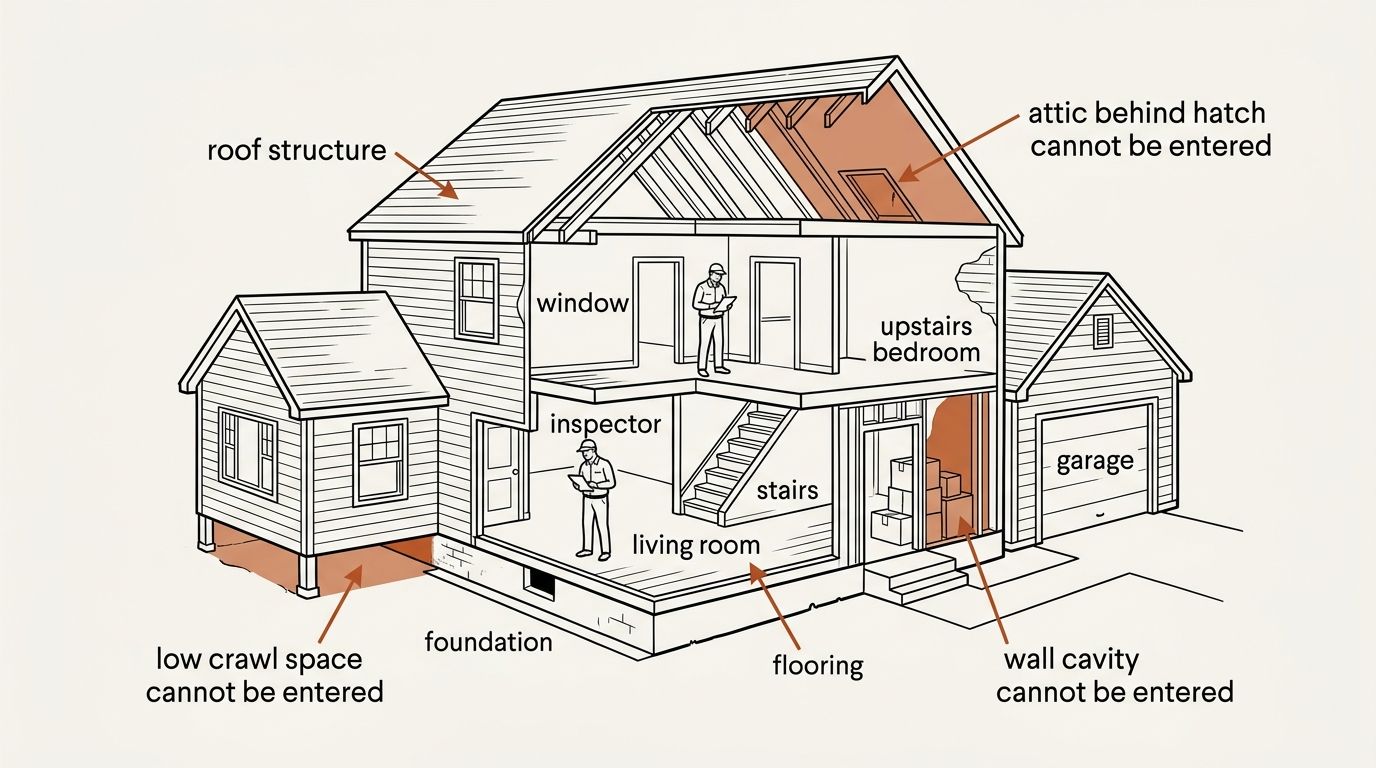
My read is that Section IV should be read before the finding in Section II. A clean box A over a Section IV listing the crawlspace, the attic and stored items is a far weaker statement than a clean box A over an empty one, and the two look identical at a glance. If a closed-off area is opened up later, the form says the company may be contacted for another inspection and that an additional fee may apply, which is worth raising before closing rather than after. What the inspector is doing in the areas they can reach is on my page about the termite inspection itself.
Is the 90 days an expiry, and whose rule is it?
It is a condition the form’s own publisher prints on page 2, and it governs the loan rather than the house.
The sentence reads: “This report shall be considered invalid for purposes of securing a mortgage and/or settlement of property transfer if not used within ninety (90) days from the date of inspection.” The next sentence closes the door people usually walk through: “This shall not be construed as a 90-day warranty.”
So the ninety days is a cut-off for underwriting, printed on the form by the trade association whose members fill it in. It is not a promise that the house stays clear for three months.
The same day-count also means different things in different places, and my read is that this is what settles it: a rule that changed meaning at a state line was never one national deadline. In Tennessee, University of Tennessee Extension summarizes the state’s law this way: “A wood-destroying insect infestation inspection report is a 90 day warranty of the accuracy of any representations in the inspection report. If there is a breach of the warranty, a person may recover compensatory damages, including all repair costs related to the warranty.” That is ninety days of liability running against the inspector, the opposite of paperwork going stale. In South Carolina, the Department of Pesticide Regulation at Clemson University publishes form CL-100, which prints on its face: “THIS REPORT IS VALID FOR 30 DAYS ONLY.”
Georgia, Alabama, Louisiana, Arizona, California, Florida and Mississippi each count something different again, and sorting out which clock applies to your own paperwork is the whole subject of how long a termite letter is valid.
Who publishes Form NPMA-33, and does it guarantee neutrality?
The National Pest Management Association publishes it, and the neutrality statement on page 2 is narrower than it sounds.
The form’s footer reads “© 2019 National Pest Management Association. All Rights Reserved”, and adds: “Previous editions are obsolete after 12/31/19. This form is approved for FHA and VA loans.” The copy quoted throughout this page is the one hosted by the US Department of Housing and Urban Development.
Page 2, item 5, says in full: “Neither the inspecting company nor the inspector has had, presently has, or contemplates having any interest in the property inspected.”
My read of item 5 is that it rules out one conflict and leaves another standing. It is about an interest in the real estate. It says nothing about whether the company that filled in Section II would like to sell you the treatment it recommended in Section III, and on many jobs those are the same company.
There is one check you can make yourself, and it is one of several on my printable inspection and report check. Section I carries a printed field for the “Company’s Pest Control Business Lic. No.”, so the number is on your copy. The EPA’s position is that “Firms offering termite services must be licensed by your state”, and it advises homeowners to “Ask to see the company’s license and, if you have any concerns, call your state pesticide regulatory agency.”
Why did your mortgage lender require a WDI report?
Because on some loans the report is a condition of the loan, tied to where the house is rather than to anything about the house itself.
The clearest example is written down. Veterans Benefits Administration Circular 26-22-11, published 15 June 2022, states that “VA requires, as a Minimum Property Requirement, a wood destroying pest inspection report for certain properties located in an area on the Termite Infestation Probability Map where the probability of termite infestation is ‘very heavy’ or ‘moderate to heavy.’” Where that applies, the circular says the Notice of Value will be conditioned for it, and repairs identified on the report must be completed before guaranty.
The same circular is the reason the fee may have landed on the buyer. It authorises charging the veteran without requiring it, and adds that “Veterans are encouraged to negotiate the cost of the wood destroying pest inspection and repairs with the seller.” Who pays for the inspection, the treatment and the repairs are three different questions, and I have gone through them separately in who pays for a termite inspection. If the phrase your lender used was “termite letter” and you are not sure that is the same errand, it is.
Does your state require a different report?
Georgia, Texas and California each prescribe a report of their own, and in those states the NPMA-33 either does not count or has to sit underneath the state form.
Georgia’s Structural Pest Control Commission rule 620-6-.03 makes its own report “the written instrument for the purpose of certifying that a structure is apparently free from wood destroying organisms as a basis for transfer of real property”. Texas prescribes form SPCS/T-5 for real estate transactions and treats a lender’s form as an add-on: under 4 TAC §7.176(b) it “is supplemental to the required department form and must be maintained in the inspection file.” California is blunter still. Its Structural Pest Control Board says “The WDO Report (form 43M-41) supersedes the NPMA-33 form in California”, and where an inspector does complete an NPMA-33, “it must be provided as an attachment to the WDO Report (form 43M-41).”
Tennessee runs the other way and prescribes no form of its own, sending inspectors to “forms prescribed by the National Pest Management Association and the Federal Department of Housing and Urban Development.”
Which rules apply to your address is worth checking before you argue with anyone about the paperwork, and I keep that in a separate guide on state termite letter requirements.
What happens if the report recommends treatment?
Section III records a recommendation, and page 2 prints the rule the inspector was following when they made it.
That rule is worth reading in full, because it tells you whether a recommendation was a judgement about your house or a default: “Treatment or corrective action should be recommended if live termites are found. If no evidence of a previous treatment is documented and evidence of infestation is found, even if no live termites are observed, treatment or corrective action by a licensed pest control company should be recommended. Treatment or corrective action may be recommended if evidence of infestation is observed, and a documented treatment occurred previously, unless the structure is under warranty or covered by a service agreement with a licensed pest control company.”
Read the middle sentence again. Old evidence plus no paperwork proving a past treatment produces a treatment recommendation with nothing alive on the property. Documentation changes the answer, which is why the seller’s records matter more than the argument does. Whether you need treatment and what a liquid barrier treatment involves are two separate questions, and the paperwork settles the first one.
One list on that form is not about your house at all. Page 2, item 4, names conditions that promote infestation: earth to wood contact, faulty grade, improper drainage, firewood against the structure, insufficient ventilation, wood mulch in contact with the structure, tree branches touching it. That advisory is preprinted on every blank copy, so its presence is not a finding. Anything an inspector actually saw at your address belongs in Section V, so check there before you treat it as one. What to do about those conditions is termite prevention, not treatment.
Here’s what I’d actually do
I would read the report backwards: Section IV first, then Section II. The finding only means something once you know how much of the house was ruled out before the inspector started.
If line 2 or line 3 is filled in and line 1 is blank, I would ask the seller one question before I asked for a single dollar: do you have records of a previous treatment, and is there a service agreement on the house? The form’s own rule turns on exactly that, so it is the question that can change the recommendation, and asking for documents reads very differently across a negotiating table than asking for a credit.
Then I would get a quote from a company that did not perform the inspection. Not as an accusation against the first one. A number with no competition beside it is not information.
I have not seen your house or your contract, and both matter here. What I am confident about is the order: what was inspected, then what was found, then what it costs, and never the other way round.
Sources
- Form NPMA-33: Wood Destroying Insect Inspection Report — National Pest Management Association, hosted by the US Department of Housing and Urban Development, form dated 2019-07-01. Accessed 2026-08-06.
- Circular 26-22-11: Pest Inspection Fees and Repair Costs — Veterans Benefits Administration, US Department of Veterans Affairs, published 2022-06-15. Accessed 2026-08-06.
- Circular 26-22-11 Change 1 — Veterans Benefits Administration, US Department of Veterans Affairs, published 2022-07-28. Accessed 2026-08-06.
- Termites: How to Identify and Control Them — US Environmental Protection Agency, updated 2025-10-21. Accessed 2026-08-06.
- Rules of the Georgia Structural Pest Control Commission, Rule 620-6-.03 — Georgia Department of Agriculture, effective 2026-04-08. Accessed 2026-08-06.
- Instructions for the Texas Official Wood Destroying Insect Report — Texas Department of Agriculture, revised 2019-09-01. Accessed 2026-08-06.
- Frequently Asked Questions Regarding the Use of the National Pest Management Association’s Wood Destroying Insect Inspection Form (NPMA-33) in California — California Structural Pest Control Board, undated. Accessed 2026-08-06.
- E&PP Info No. 714, Summary of the Federal and State Pesticide Laws and Regulations — University of Tennessee Extension Pesticide Safety Education Program. Accessed 2026-08-06.
- Official South Carolina Wood Infestation Report, Form CL-100 — South Carolina Department of Pesticide Regulation, Clemson University. Accessed 2026-08-06.
Common questions
What happens if my closing slips past the 90 days?
The form states the report is invalid for securing a mortgage or settling a property transfer if it is not used within ninety days of the inspection date, so a lender will need a current one rather than an extension of this one. That is a scheduling problem, not a finding about the house, and it is not a reason to skip a second quote on any treatment being discussed.
Does the NPMA-33 cover wood rot or mold?
No. The form says the inspection covers termites, carpenter ants, carpenter bees and reinfesting wood boring beetles, and that it "does not include mold, mildew or noninsect wood destroying organisms." The form has a separate Wood Destroying Organism Attachment, which the California Structural Pest Control Board refers to by name, and your lender may or may not have asked for it.
Who is allowed to fill in this form?
Someone licensed by the state, and the report carries the proof. Section I has a printed field for the company's pest control business license number, so it is on your copy. The EPA's position is that firms offering termite services must be licensed by your state, and it advises asking to see that license and calling your state pesticide regulatory agency if anything concerns you.
- wdi
- npma-33
- home buying
- inspection
Related reading
real-estate
How Long Is a Termite Letter Valid?
A termite letter is a written report from a licensed inspector detailing whether a building shows visible evidence of wood-destroying insects on the date of inspection.
A termite inspection in a house purchase is a visual examination of the parts of a building one licensed inspector could reach on one day, written up on a form your lender reads.
real-estate
Termite Letter Requirements, State by State
A termite letter is a report from a licensed pest control company saying whether it found termites or other wood-eating insects at a house. Your lender will usually want one before you close.
A wood-destroying insect (WDI) inspection determines whether a home has active termites or past damage before a property transfer closes.