 Termite Registry
Liquid Barrier Treatment
A liquid barrier treatment is a continuous zone of treated soil around and beneath a building, applied so that subterranean termites die crossing it on their way to your house. Registered products have to keep working for at least five years. The whole job turns on the word continuous.
Kentucky’s extension service explains what that means in practice better than any sales visit will:
“Even the best treatments performed by knowledgeable pest control firms may fail at times, when termites find their way through untreated gaps in the soil. While the intent is to establish a continuous, impenetrable chemical barrier, this is hard to achieve in actual practice.”
What it costs
The volume of termiticide your house needs is arithmetic, and you can do it before anyone quotes you.
Termiticide is applied at a rate of 4 gallons per 10 linear feet, per foot of depth, down to the top of the footing. That figure is on the EPA-accepted label for Termidor SC, and NC State Extension describes it as the rate for most termiticides. NC State works the example:
“a house that has a 40 ft x 30 ft ‘footprint’ (120 linear feet) and a one-foot deep footer would require 48 gallons of termiticide spray just to treat the soil along the outside foundation wall… The total amount of chemical needed will depend on whether the interior foundation wall needs to be treated (in part or all of it) and on other aspects of the building construction (such as attached garage slabs, earth-filled porches, etc.) but could easily exceed 100 gallons.”
Measure your perimeter, find out how deep your footing is, and do the multiplication. Then ask each bidder how many gallons they are quoting. A bid well under the label rate is a bid for a different, thinner job, and now you can see it.
What it actually does
The modern products do not repel termites. They kill the ones that tunnel into treated soil, and that distinction is the most important thing to understand about how this changed.
Older termiticides were repellent, mostly pyrethroids, and UC IPM explains the problem with them:
“Subterranean termites can detect repellent insecticides, usually pyrethroids; and they are repelled without receiving a dose that would kill them.”
A repelled termite is a live termite looking for the gap. The current actives, fipronil, imidacloprid and chlorantraniliprole, are non-repellent, and Kentucky’s extension service says they “are usually more reliable controlling infestations in the first attempt.”
There is a secondary effect worth knowing about. Termites share gut contents by trophallaxis, so a slow-acting non-repellent can reach individuals that never touched treated soil. LSU AgCenter researchers found that a fipronil spot treatment “effectively killed termites that were not in the treatment site.” That is real, and it is not colony elimination. No extension source claims a liquid barrier wipes out the colony, and if a salesperson tells you it does, that is a sales claim rather than a sourced one.
The termites already inside your walls usually die as well, which surprises people. Kentucky: “termites already within the building die off as well, since they cannot return to the soil for supplemental moisture.”
How the job is actually done
A trench goes around the foundation. The Termidor SC label sets the dimensions: “trenches must be a minimum of 6 inches deep (no deeper than the bottom of the footing) and need not be wider than 6 inches.” NC State describes 4 to 6 inches wide, 6 inches deep, and the product gets mixed into the soil as it goes back in rather than poured on top.
Where concrete meets the foundation, the crew drills. NC State lists what that covers:
“In cases where there are dirt-filled porches, they must either be accessed and treated from the crawlspace, or drilled and rodded (vertically or horizontally). In addition, walkways and driveways preventing the trenching of soi[l] must be drilled, and liquid flooded under the slabs via rodding. Within garages the cement or expansion joints must also be drilled and rodded.”
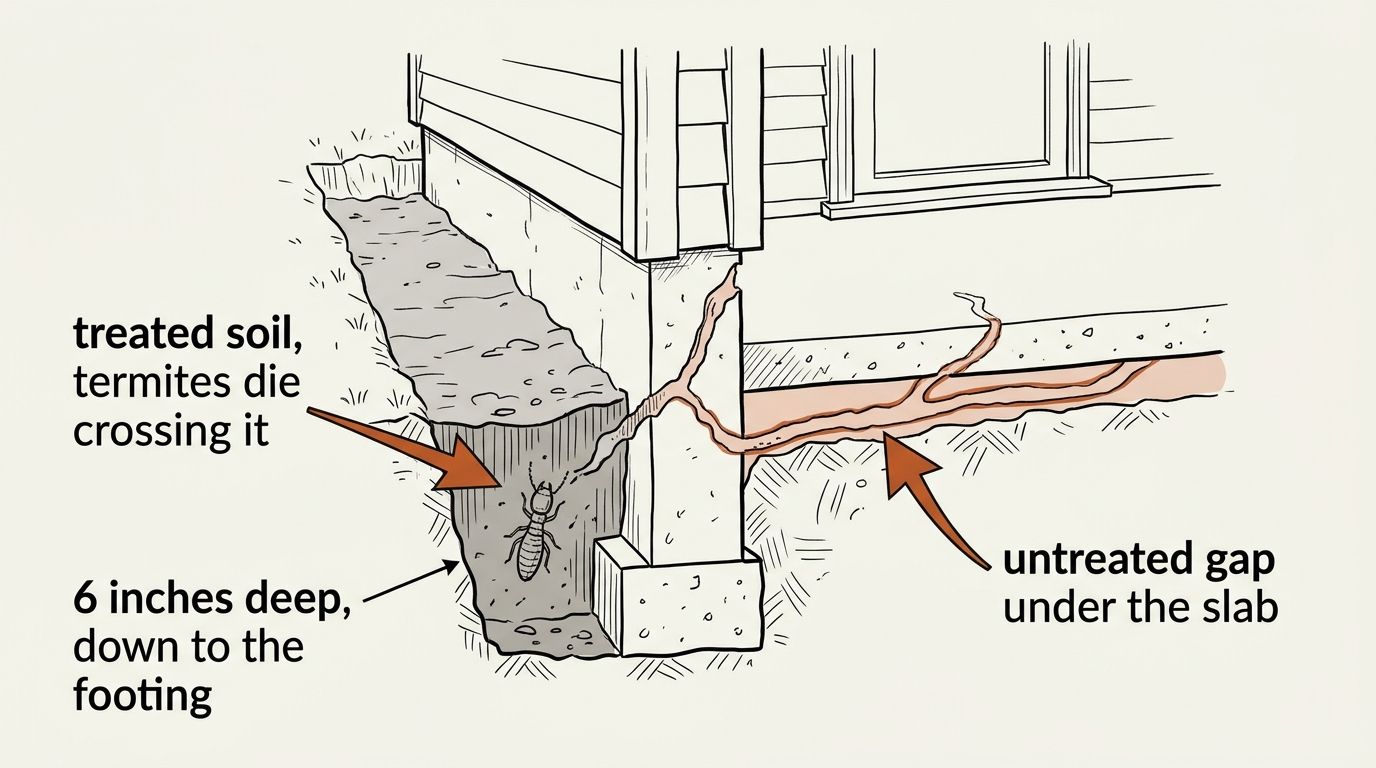
Rod holes are spaced no more than 12 inches apart along the whole run. If the soil will not take the labelled volume, the label allows doubling the concentration and halving the volume, with a warning attached that matters: “Large reductions of application volume reduce the ability to obtain a continuous treated zone.”
How long it takes, and how long it lasts
It works quickly. There is no clean published figure for days-to-control in an actual house, but the comparison against baiting is documented and lopsided: baits are “relatively slow-acting compared to the effects of liquids.”
Longevity is better documented. Every registered liquid termiticide is “supposed to control termites for at least five years when applied according to label directions,” and Mississippi State Extension reports that better products have run 8 to 12 years in USDA Forest Service trials, while suggesting retreatment at roughly ten years.
What shortens it is almost always water or a shovel. Rain and irrigation leach the treated band, and digging removes it outright. Which brings up the single most useful correction on this page: if termites turn up the year after treatment, the chemical did not wear out. Kentucky again, and this sentence is worth quoting to your contractor:
“If termites swarm and continue to infest the structure the year following treatment, it is not from degradation of the termiticide— but rather, because the pests have found an untreated gap in the chemical barrier.”
That reframes the conversation from “time for another treatment” to “you missed a spot,” and those have very different price tags.
When it is the right call
Confirmed subterranean or Formosan activity, soil you can actually get to, and a reason to want this handled on a schedule. If you are selling or refinancing, speed is the deciding factor and this is the method that delivers it.
It is also the option that keeps working if life gets in the way. Mississippi State makes a point about lapsed contracts that nobody selling baits will mention: a properly applied liquid treatment keeps controlling termites “even if the annual renewal fee is not paid and the termite contract is allowed to lapse,” because the chemical is still in the soil. You lose the inspections and the warranty. You do not lose the treatment.
Kentucky also considers it reasonable on a house that has never been treated at all: “Preventively treating a home for termites is a prudent investment, especially if the structure has had no prior history of treatment.”
When it is not, and what I would do instead
Drywood termites. UC IPM is unambiguous that drywood nests “remain entirely above ground and do not connect to the soil.” A soil barrier is aimed at a colony that is not there. If what you have is pellet piles rather than mud tubes, read subterranean versus drywood before you buy anything, because this is the expensive mistake in this whole subject.
A well or cistern within about ten feet. The Termidor SC label prohibits application within 5 feet of a well or cistern outright, and soil between 5 and 10 feet may only be treated by mixing it in a wheelbarrow and putting it back. NC State adds a detail that catches people: the restriction “applies even if the well is not in use.”
Foundation or French drains. These can carry termiticide to wherever the drain empties. NC State tells homeowners to make sure the company knows about the drain before work starts, and I would put that in writing rather than trust a walkthrough.
Sub-slab heating ducts, plenums, inaccessible crawlspaces. Kentucky notes that in these cases “no warranty will be offered” because the job cannot be done to industry standard. If the barrier cannot be made continuous, you are paying for something that is a gap by design, and I would take bait stations instead.
Aerial infestations. If termites are living in the structure with no soil connection, usually on a moisture problem, NC State says plainly these “cannot be controlled with the usual soil treatment” and are typically excluded from the warranty. Fix the leak first.
The alternative, fairly stated
Bait stations go after the colony rather than the ground around your house, they need no trenching or drilling, and they are the only workable option where a liquid is restricted. They are also much slower, averaging 10.5 months to control in a Texas field trial, and they leave nothing in the soil when the servicing stops.
The strongest argument against liquid barriers comes from UF/IFAS, which reported in 2024 that a liquid treatment reached only about 8 feet 4 inches out from the structure and affected “as little as 1.5%” of the colony population. The house is protected. The colony is still in your yard.
Whether that bothers you depends on what you think you bought. Kentucky’s line settles it for me: “colony elimination is not always necessary to afford structural protection.”
What goes wrong
Gaps, and then everything that creates one. Plumbing and electrical penetrations through a slab are the classic entry, because concrete shrinks away from pipes as it cures. Additions and porches get missed. Firewood, mulch and stacked cardboard against the foundation let termites bridge straight over the treated band, which Kentucky notes “may allow termites to bypass surrounding soil treated with a termiticide.”
Then there is what you do to the treated band yourself, months after the crew has gone. Digging along the foundation removes the treatment and, as NC State warns, most contracts say it voids your guarantee too. Call the company before you install a drain, waterproof a wall, or re-landscape.
One genuine disagreement worth flagging, because it affects what you should expect. LSU AgCenter’s laboratory work found that slower non-repellent products can develop a repellent effect over several days as dead termites and fungus build up in the treated soil, stranding live termites above ground. That is a lab study rather than a field trial, and it qualifies the tidy claim that termites simply cannot detect these products.
What to ask before you sign
- “Repellent or non-repellent, and which active ingredient?”
- “How deep is my footing, and how many total gallons will you apply?” Check it against the label rate.
- “Will you trench a minimum of 6 inches deep, down to the top of the footing?”
- “Which slabs, porches, walkways and garage joints get drilled, and which do not?”
- “Is there a well, cistern or water pipe within 10 feet, and will you use the backfill method?”
- “Do I have a foundation drain, and where does it discharge?”
- “Can I see the actual product label you will use, not the safety data sheet?”
- “Will I be asked to sign a waiver of minimum standards, and what exactly is being waived?”
- “Retreat-only warranty, or does it include damage repair?”
Here’s what I’d actually do
I would get the gallon number in writing from every bidder before comparing prices, because it is the one specification that tells you whether they are quoting the same job. Two bids that differ by 40% usually differ in scope, not in greed, and until you have the volumes you cannot see which.
And if termites came back within a year of a previous treatment, I would not buy a retreatment. I would take Kentucky’s sentence to whoever did the original work and ask them to find the gap under the warranty they sold me.
Sources
- Termite Control: Answers for Homeowners (ENTFACT-604) — Michael F. Potter, University of Kentucky Department of Entomology, revised March 2026. Accessed 2026-08-04.
- Protecting Your Home Against Termites (ENTFACT-605) — University of Kentucky Department of Entomology, revised March 2026. Accessed 2026-08-04.
- Monitoring and Management of Eastern Subterranean Termites — Charles Hayes and Patricia Alder, NC State Extension, published 2025-01-22. Accessed 2026-08-04.
- Termites — Treating Houses with Wells, Cisterns or Foundation Drains — Michael Waldvogel, Patricia Alder and Charles Hayes, NC State Extension, published 2017-06-21, reviewed and revised 2022-04-08. Accessed 2026-08-04.
- Pest Notes: Subterranean and Other Termites (Publication 7415) — UC Statewide IPM Program, content updated May 2014. Accessed 2026-08-04.
- Pesticide product label, Termidor SC, EPA Reg. No. 7969-210 — BASF, accepted by the US Environmental Protection Agency 2023-08-15. Accessed 2026-08-04.
- Methods of Termite Control and Common Questions about Termites and Termite Control — Blake Layton, Mississippi State University Extension Service. Neither page carries a printed publication or revision date. Accessed 2026-08-04.
- Henderson, G., Gautam, B. K. and Wang, C. (2016). Impact of ground-applied termiticides on the above-ground foraging behavior of the Formosan subterranean termite. Insects 7(3): 43, published 2016-08-26. LSU AgCenter. Full text. Accessed 2026-08-04.
- New UF study shows liquid insecticides have limited impact against subterranean termite colonies — University of Florida IFAS, posted 2024-07-22. Accessed 2026-08-04.
Where it works well
- Fast. The modern non-repellent products are usually more reliable at controlling an infestation on the first attempt.
- Something stays in the soil afterwards, so protection does not end the day you stop paying.
- Termites already inside the building usually die too, cut off from the soil moisture they need.
- Works on a definite schedule, which matters when there is a closing date.
Where it falls short
- A continuous treated zone is hard to achieve in practice, and one gap is a doorway.
- Means trenching the perimeter and drilling through patios, walkways, garage joints and sometimes finished floors.
- Does nothing whatsoever for drywood termites.
- Wells, cisterns, water bodies and foundation drains restrict or prohibit application near them.
Common questions
How many gallons should my house need?
Ask for the number before work starts, because you can check it. The rate on the Termidor SC label is 4 gallons per 10 linear feet per foot of depth down to the footing. NC State Extension works a 40-by-30-foot house with a one-foot footer at 48 gallons for the exterior wall alone, and notes the total could easily exceed 100 gallons once interior walls, garage slabs and earth-filled porches are included.
Termites came back the year after treatment. Did the chemical wear off?
Almost certainly not. Kentucky's extension service is direct about this: if termites reappear the year after treatment, it is not degradation of the termiticide but termites finding an untreated gap in the barrier. Products are tested to control for at least five years. A first-year return is a gap in the application, which usually means it is a warranty conversation rather than a retreatment purchase.
Can I buy Termidor and do this myself?
Not legally in most cases, and not practically in any. The Termidor SC label restricts sale and use to individuals and firms licensed or registered by the state to apply termiticides, and using a pesticide against its label is a federal violation. Beyond that, the job needs a hundred-odd gallons, a masonry drill, and soil rods. NC State Extension does not recommend the DIY route for chemical termite control.