 Termite Registry
Termite Bait Systems
A termite bait system is a ring of plastic stations sunk into the soil around a building, each holding cellulose that termites eat and carry back to the nest. It goes after the colony rather than the ground against your foundation, and the part nobody leads with is how long that takes.
A Texas field trial published in 2015 averaged 10.5 months from installation to control.
That is the trade. You are buying a slower and more thorough approach, on a subscription.
What it costs
Baiting is priced as an installation plus a recurring fee, and the recurring fee is the one people underestimate.
NC State Extension puts the renewal on a bait contract at two to four times the renewal on a liquid treatment, and explains why: bait stations get checked anywhere from once to four times a year, where a liquid-treated house is inspected annually. You are paying for visits.
Kentucky’s extension service makes the same point about the total, noting that baiting “can sometimes be costlier than a liquid treatment because more visits may be required to monitor for termites, and add or replenish baits.”
Ask for the installation figure and the renewal figure separately, in writing. The installation number alone tells you very little about what this costs over fifteen years.
What it actually does
The stations do not attract anything, and this is the most common misunderstanding about them. NC State Extension addresses it head-on: the systems “do not ‘attract’ termites,” and workers find them “during their atrual foraging activities, just as they might find any other underground food source, such as the roots of tree stumps or buried (and untreated) wood.” (The typo is in the original.)
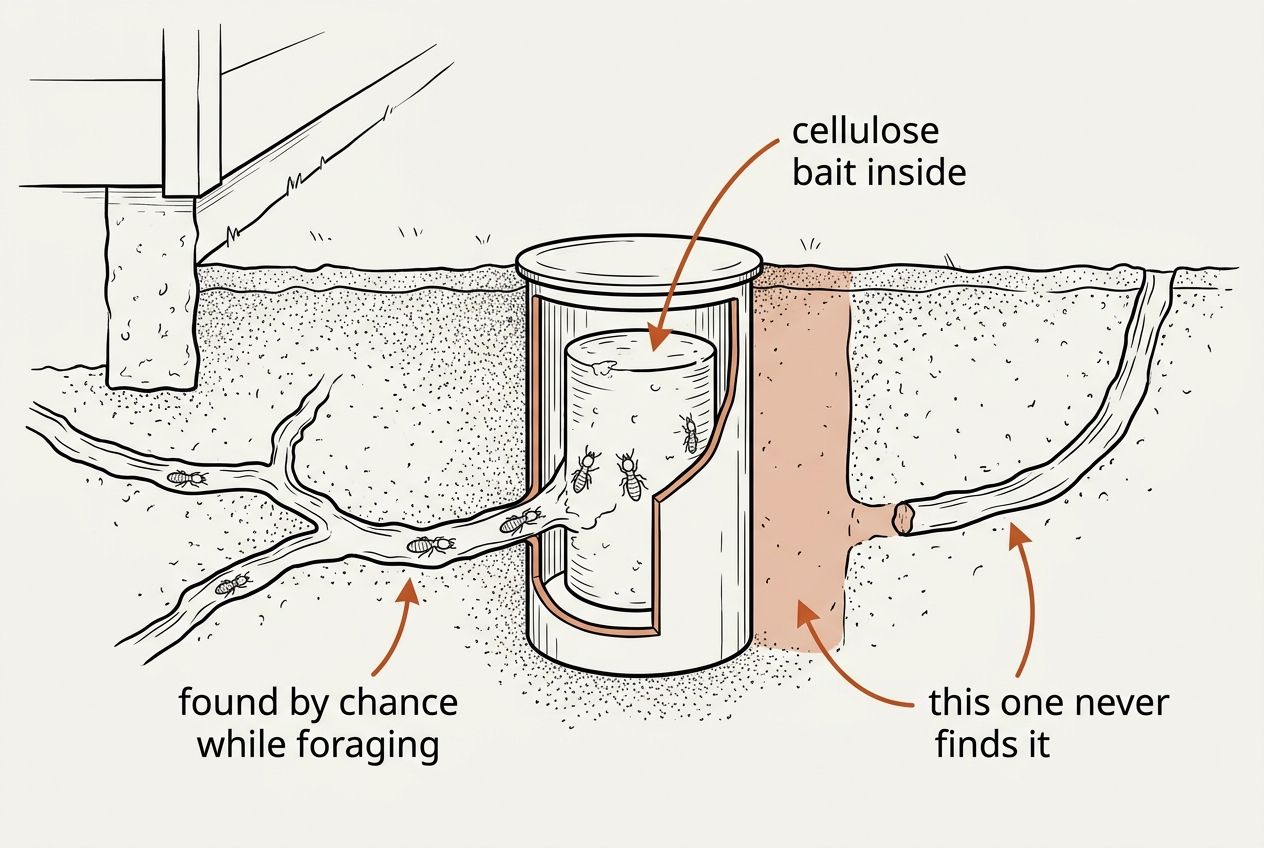
Once termites do find a station, the chemistry is deliberately unhurried. The active ingredients are insect growth regulators: noviflumuron in Sentricon’s Recruit baits, diflubenzuron in Exterra’s Labyrinth, novaluron in BASF’s Trelona. NC State describes what they do, which is that the IGRs “disrupt the ability of the insects to molt, which means that they only affect immature termites that are still growing.”
You might reasonably ask how killing only the immature ones helps. Here is the answer, and it is the whole mechanism:
“However, most of the colony is made up of immature termites (larvae and nymphs) which can be affected. As a result, it may take several months before the entire colony is substantially reduced or even eliminated. As the workers die, there are fewer termites available to collect food and feed the rest of the colony. Eventually, the king and queen (and soldiers) starve to death and the colony dies off.”
The queen is never poisoned. She starves, because the workers who fed her are gone. The slowness is the design rather than a defect in it, since a fast-acting poison would kill the foragers before they carried anything home.
How long it takes, and how long it lasts
Two clocks run here, and the first one is the one that tests your patience.
Finding the stations. Keefer and colleagues, publishing in the Journal of Economic Entomology in 2015, recorded a mean of 5.1 months from installation to the first termite activity on a bait cartridge, ranging across structures from 2 to 10 months. The California Structural Pest Control Board’s field study ran longer and came out bleaker: across 180 bait stations over two years, the average interception time was 367 days, and only 44% of stations were ever hit at all.
Then control. The same Texas trial averaged 10.5 months from initial installation to control of the infestation, or 5.4 months counted from when the bait itself went in.
The California board turned up something genuinely counterintuitive along the way. Stations installed in December were found faster than stations installed in June, 194 days against 296, and the difference was statistically significant. Installing in the warm months feels right and appears to be wrong.
How long the protection lasts is simpler: exactly as long as the stations do. Kentucky’s extension service is explicit that “there is no residual pesticide left in the soil after the termites have been eliminated,” so ongoing protection “depends on retaining the stations in the soil and periodically monitoring them.”
When it is the right call
Sometimes a liquid barrier is not merely inconvenient but genuinely unavailable, and that is where baiting stops being a preference and becomes the answer. Kentucky’s extension service lists the conditions:
“Some buildings have wells, cisterns, nearby ponds or streams, plenums, sub-slab heating ducts, drainage systems, inaccessible crawl spaces, or other features that complicate treatment of soil with a liquid. With baits, such conditions aren’t a problem and may be the only feasible form of treatment. Houses that were unsuccessfully treated with liquids also are candidates for baits.”
The last sentence is worth sitting with. A house that got a liquid barrier and has termites anyway is a candidate precisely because whatever that barrier missed, the stations do not depend on.
The other clean case is a slab where doing the liquid job properly means drilling through tile, hardwood, or a finished basement wall. The stations go in the yard instead.
When it is not, and what I would do instead
If you are selling the house, this is the wrong product. Kentucky states the problem plainly: homeowners “with a severe termite infestation or those involved in a real estate transaction may not want to wait this long.” A closing date and a ten-month average do not fit together.
In California it is not even a judgement call. The state’s pest control board notes that under the Structural Pest Control Act, “baits may not be used to financially ‘clear’ infested structures.” If you need paperwork for a sale, baiting cannot produce it there.
The other case where I would not start with baiting is heavy active damage in the structure right now. Ten months of feeding while the stations wait to be discovered is real damage, and the honest move is a liquid treatment at the points of known activity, with stations going in alongside if you want them.
If none of that describes you, the slowness costs very little. Termite damage runs in years, not weeks.
The alternative, fairly stated
A liquid barrier is the other way to do this, and on speed it wins outright. Kentucky’s extension service says the modern non-repellent products, meaning fipronil, imidacloprid and chlorantraniliprole, “are usually more reliable controlling infestations in the first attempt.”
The counter-argument deserves a hearing because it comes from the institution that developed baiting. UF/IFAS researchers reported in July 2024 that a liquid treatment’s effect on the colony itself is smaller than most people assume: the treated “death zone” reached about 8 feet 4 inches out from the structure, and as little as 1.5% of the colony population was affected. The house is protected. The colony in the yard is largely still out there.
Which framing is right depends on what you think you are buying, and Kentucky’s own guide contains the line that reconciles them: “colony elimination is not always necessary to afford structural protection.” Baiting aims at the colony. A barrier aims at your house. Both are legitimate targets, they are not the same target, and that is why this argument never resolves.
What goes wrong
Termites never find the stations. That is not hypothetical, it is the 56% of California’s stations never hit in two years, and it is why NC State warns there is “no way to predict how soon termites will find and feed in a bait station.”
Weather interferes with the search too. Cold soil slows foraging, and the label for Recruit HD notes feeding “typically declines during periods when the local historical average daily temperature falls below 50°F.”
Then there is the ordinary way this fails, which is that someone stops paying.
What to ask before you sign
- “Is bait in the stations from the day you install them, or do you put monitors in first and add bait only once termites turn up?” Both designs are sold and the timelines differ.
- “How many visits a year, and is that number written into the agreement?” This is the cost driver and the efficacy driver at the same time.
- “If termites have not found a station in twelve months, what do you do then?”
- “I have active termites in a wall right now. Are you treating those points with a liquid as well?”
- “Does the warranty cover repairing damage, or only re-treating?”
- “If I cancel or sell, do the stations come out or stay in the ground, and who owns them?”
- “What is the renewal, and what stops the day I do not pay it?”
Here’s what I’d actually do
If my house had a well, a foundation drain, or a slab that would need drilling through finished floors, I would take the bait system and accept the wait. Those are the cases where the alternative is illegal, impossible, or destructive, and the decision makes itself.
Anywhere else, with active termites in the structure, I would treat the known activity with a liquid first and then decide separately whether I want stations for the long term. Ten months is a long time to watch a wall.
And I would ask the renewal question before the installation question. Installation is a one-time number that gets quoted competitively, so it is the number companies compete on. The renewal is what you pay every year for as long as you own the house, and it is the one people forget to compare.
Sources
- Termite Baits: A Guide for Homeowners (ENTFACT-639) — Michael F. Potter, University of Kentucky Department of Entomology, revised March 2026. Accessed 2026-08-04.
- Termite Control: Answers for Homeowners (ENTFACT-604) — Michael F. Potter, University of Kentucky Department of Entomology, revised March 2026. Accessed 2026-08-04.
- Termites — Baiting Systems — Michael Waldvogel, Patricia Alder and Charles Hayes, NC State Extension. Published 2017-06-19, reviewed and revised 2020-04-13. Accessed 2026-08-04.
- Evaluation of bait station system efficacy for reduced-risk subterranean termite management in CA — Andrew Sutherland and colleagues, California Structural Pest Control Board. Final report covering 2018-10-10 to 2022-08-31. Accessed 2026-08-04.
- Keefer, T. C. and colleagues (2015). Field trials with 0.5% novaluron insecticide applied as a bait. Journal of Economic Entomology 108(5): 2407–2413. Copy hosted by Texas A&M Urban Entomology. Accessed 2026-08-04.
- Pesticide product label, Recruit HD, EPA Reg. No. 62719-608 — Corteva Agriscience, accepted by the US Environmental Protection Agency 2024-01-03. Accessed 2026-08-04.
- New UF study shows liquid insecticides have limited impact against subterranean termite colonies — University of Florida IFAS, posted 2024-07-22, reporting work by Thomas Chouvenc. Note that the Sentricon system was originally researched at UF. Accessed 2026-08-04.
Where it works well
- Works where a liquid cannot legally or physically go: wells, cisterns, sub-slab heating ducts, drainage systems, inaccessible crawlspaces.
- No trenching, and no drilling through finished floors or patios.
- Aims at the colony rather than the soil around the house.
- Every service visit is also an inspection.
Where it falls short
- Slow. Termites have to find the stations first, and nobody can tell you when that will happen.
- Nothing is left in the soil, so protection ends when the servicing does.
- Renewal costs run higher than a liquid contract, because someone has to keep visiting.
- In California a bait system cannot be used to clear a structure for a sale.
Common questions
How many stations will my house need?
Nobody publishes a number, because it is not a number. It is a spacing rule applied to your perimeter. NC State Extension puts stations 2 to 4 feet from the foundation and no more than 20 feet apart; Kentucky's extension service describes 10 to 15 feet as typical. Measure the perimeter and divide. A contractor quoting a station count without walking the property is guessing.
What happens to the stations if I cancel?
NC State Extension is blunt about it. If you discontinue the contract, the company usually removes the stations or simply stops servicing them, and either way you are left with little or no chemical protection, because baiting leaves nothing behind in the soil. Ask before signing whether the stations get pulled or abandoned, and get that answer in writing.
Can baiting be the only treatment, or do I need a liquid too?
It can be the only treatment. NC State Extension states that all currently approved professional termite bait products are registered for standalone use. Plenty of companies still pair stations with a spot liquid application at known activity, and Kentucky's extension service describes both arrangements as normal practice. Ask which one you are being sold, and why.