 Termite Registry
Whole-Structure Fumigation
Whole-structure fumigation means sealing the building under tarpaulins and filling it with sulfuryl fluoride, a colorless, odorless gas that penetrates wood throughout the structure. It is the only treatment that reaches drywood colonies nobody managed to find, and it leaves nothing behind afterwards.
That last part surprises people, so it is worth stating early. Fumigation is not a barrier and confers no protection. Texas A&M puts it in six words: “Tent fumigation gives no residual protection against termite re-infestation.”
What it costs
One figure exists in the literature, and it is a state total worked backwards rather than a quote. A UF/IFAS entomologist, writing in February 2023, used an average of $2,000 per fumigation to calculate that Floridians spend about $91 million a year tenting for drywood termites. Treat that as a planning number for the state of Florida. It is not what your house will cost, and one average is not a range.
How the price is built is the part you can use, because fumigation is engineered by volume. The applicator must record the cubic footage of the space before starting, and the gas dose is calculated in ounce-hours per thousand cubic feet from that volume, the temperature, the exposure time, and how fast the tent leaks.
Four things move the number, all of them from the label’s own dose inputs: the volume of the building, the temperature, the seal quality, and the target pest. That last one matters more than you would think. If the job also targets Formosan termites the dose is four times the drywood rate, and for powderpost beetles it is ten times.
One more, and it cuts the other way: a non-monitored fumigation uses 33% more gas than a monitored one, all else equal, because the crew is compensating for not knowing the real leak rate.
What it actually does
The gas spreads through the structure and into the wood. NPIC describes it plainly: sulfuryl fluoride “spreads out and seeps into cracks and pores,” which “allows it to reach pests throughout the home, including those found within wall voids and porous materials like wood and fabric,” where it releases fluoride into the insects and their cells stop making energy.
That penetration is the entire point, because the alternative treatments all depend on somebody correctly locating a colony. UC IPM sets out the difference: whole-structure treatments “should eliminate all infestations, even hidden ones,” where with localized treatment “one can never be sure all infestations have been treated.”
Monitored versus non-monitored is the quality distinction to ask about. A monitored fumigation runs gas lines inside the structure so the crew can see the actual concentration. UC IPM: a monitored fumigation “has the highest rate of treatment success. Nonmonitored fumigation may not have enough gas concentration to kill infestations, and failures may occur.”
Methyl bromide, the older fumigant, was phased out on 1 January 2005 and may not be used in residential structures at all. Sulfuryl fluoride is now the only structural fumigant with residential uses.
What you have to do to your house
Everyone leaves. The California pest control board puts the range at six hours to a week depending on infestation, dose, temperature and size.
Food, feed, drugs, tobacco and medicines have to go, or be double-bagged in Nylofume bags supplied through the fumigant distributor — and that includes what is in the fridge and the freezer. Ordinary ziplock bags do not qualify. Anything still sealed by the manufacturer in glass, metal or plastic can stay.
Mattresses and pillows in waterproof covers have to be opened or removed. Pilot lights get extinguished. Pets, fish and plants go, and so do seeds and bulbs meant for planting.
Because the gas has no smell, the crew must release chloropicrin first, at least 5 to 10 minutes ahead, as a warning agent. It is genuinely unpleasant, it makes your eyes sting, and it clears the building more slowly than the fumigant does, which is why a house can smell odd after clearance.
Re-entry is gated on a measurement, not a clock. A certified applicator must confirm 1 part per million or less in the breathing zone of each room. Aeration alone runs a minimum of 14 to 24 hours at doses above 16 ounces per thousand cubic feet.
How long it lasts
It does not. This is the single most important sentence about fumigation and the one least likely to come up on a sales visit.
California’s pest control board: “Since fumigants have no residual effect, other household pests can reinfest the structure after a fumigation.” The building is exactly as attackable the week after as the week before, and drywood swarmers arrive by air.
Historically the reinfestation rate was not trivial. A 1964 Los Angeles study found 26 to 37% of fumigated structures showed active drywood infestation again within three to five years.
The board also flags a false alarm worth knowing about: pellets and dust stay in the tunnels after the insects are dead, so you may keep seeing them. That does not mean the fumigation failed. Drywood termites can also stay alive up to a week after receiving a lethal dose.
When it is the right call
When you cannot say where the termites are. That is the honest trigger, and everything else follows from it.
Pellet piles in unrelated parts of the house, activity behind wall coverings, a structure where localized work has already been tried and failed. UC IPM notes that with drywall concealing infestations “there is always some doubt as to the extent of drywood termite colony boundaries and the number of colonies within homes.”
Texas A&M is blunter: “The most effective treatment for structural infestations of drywood termite infestations is tent fumigation.”
There is also a consumer lever most people never hear about. In California a homeowner can hand an inspection report from one company to a separate fumigation company and contract the tenting directly. The inspection and the treatment do not have to be bought from the same firm, which is a real answer to the inspect-and-upsell problem.
When it is not, and what I would do instead
Subterranean termites. This is the expensive mistake, and UC IPM leaves no room in it:
“Subterranean termites in structures cannot be controlled using techniques that are appropriate for drywood termites, such as fumigation, heat treatment, freezing, and termite electrocution devices, because the reproductives and a large majority of the termites are concentrated in nests near or below ground level out of reach of these control methods.”
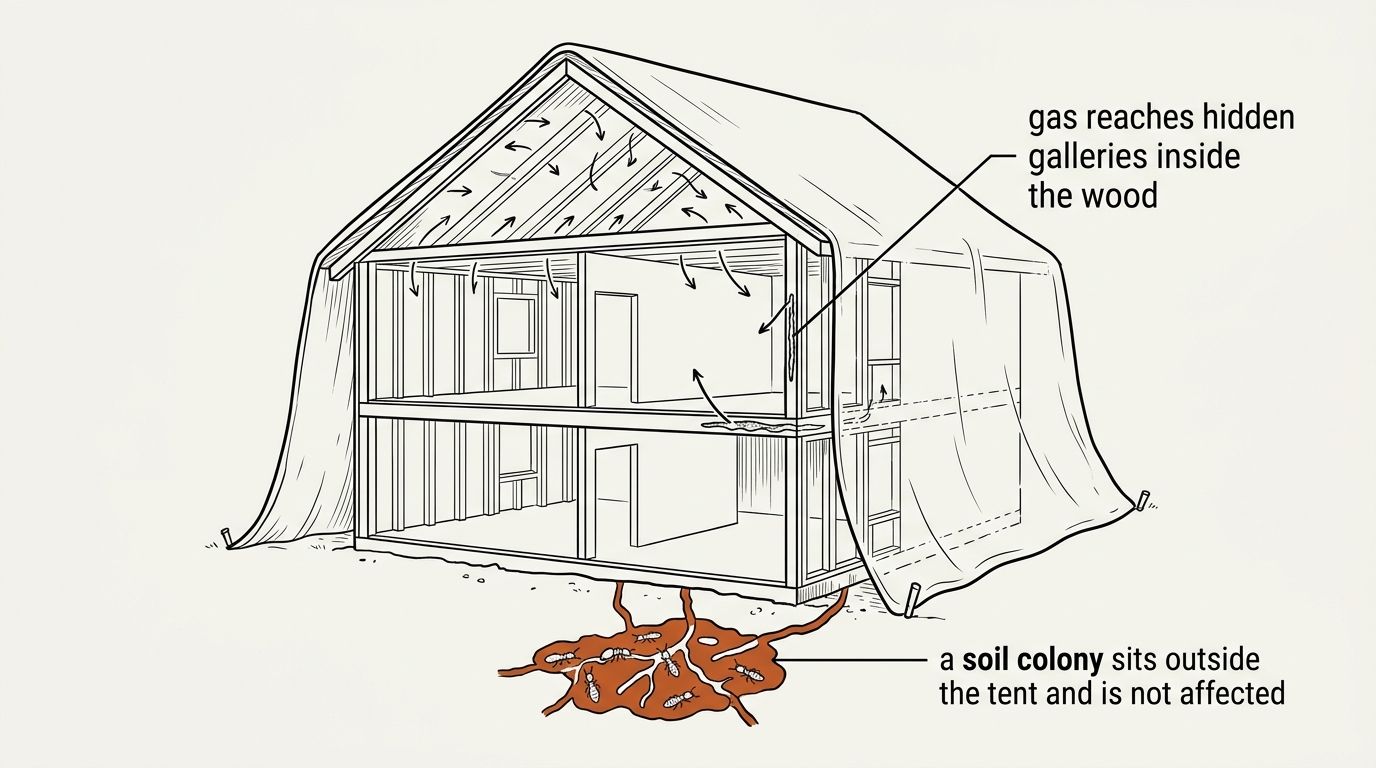
A tent kills what is inside the tent. A subterranean colony’s queen and most of its workers are in the soil, outside the sealed envelope, entirely untouched. California’s board says the same thing in one word when asked whether fumigation handles everything: “No. Subterranean termites require separate treatments.” If your evidence is mud tubes rather than pellets, you want a liquid barrier or bait stations, and tenting would be money set on fire.
Genuinely localized activity. One accessible infested board does not need a tent. The board is explicit that fumigation “is not always required,” and spot treatment is reasonable when the infestation really is confined.
Structures that cannot be sealed. With tape-and-seal rather than tarps, the label warns that “fumigant can leak through the building walls and roof at an unknown rate” and that the dose calculator “may not accurately estimate” it. If your building falls in that category, insist on monitoring.
The alternative, fairly stated
Whole-structure heat is the only other method that treats an entire building. It raises all wood to a minimum of 120°F and holds it for at least 33 minutes, uses no chemicals, and gets you back in within hours rather than days. On a large or heavily furnished house it can also treat sections separately, which suits apartments.
The catch is consistency. UC IPM rates fumigation’s field efficacy as high when monitored, but heat as “variable depending on structural size and amount of wall covering & furnishing,” and says the ability of heat devices to clear large structures with layered wall coverings “still remains unclear.” Heat sinks, meaning wood against concrete or tile, are hard to bring up to temperature.
Worth knowing that the sources do not agree on heat’s own protocol. UC IPM says 120°F for 33 minutes, California’s board describes heating the air to 140–150°F until timbers reach 120°F, and Texas A&M says 135°F for at least 60 minutes and notes the method is not approved for use in Texas. Three Tier 1 sources, three protocols.
What goes wrong
Underdosing, and it is the failure that matters because of how the egg logic works. Texas A&M: “only fumigation at the proper chemical concentration, is likely to kill all the termites in a structure. If even a few termites survive, they can tend the eggs and sustain the colony.”
Then the ordinary physical failures. Tarps get dragged over roofs and damage them. Appliances left closed hold gas and have to be opened during clearance. Plants outside the tent get hurt if the soil is not wetted first.
The failure that has actually killed people is somebody going back inside before clearance. EPA’s Office of Inspector General reported in December 2016 that since 2002 at least 11 deaths and two serious injuries occurred during residential fumigations in California and Florida, and named three contributing factors: no requirement to secure tenting, ineffective clearance devices, and applicators skipping mandatory training. All three have since been tightened on the label. Secondary locks that only the company can open are now required on every exterior door, which is why you cannot get back into your own house early even if you want to.
What to ask before you sign
- “Have you positively identified this as drywood rather than subterranean, and what did you see?”
- “Will this be monitored, with gas lines inside the structure?”
- “What cubic-foot volume did you calculate, and what dosage are you targeting?”
- “Which clearance device do you use, and may I see the reading before I go back in?”
- “Has your crew done the annual stewardship training?”
- “There is no residual after this. What does the warranty actually cover?”
Here’s what I’d actually do
I would get the identification nailed down before anything else. Fumigation is a large, disruptive, expensive treatment that does nothing at all for the most common termite in the United States, and the difference between mud tubes and pellet piles decides which page you should be reading.
Given confirmed, widespread drywood activity, I would tent it and I would pay for the monitored version specifically. The 33% extra gas on a non-monitored job tells you the industry knows it is compensating for a blind spot, and UC IPM’s line about non-monitored fumigations lacking enough concentration is the one failure mode I would not gamble on.
Then, because there is no residual, I would put an inspection on the calendar rather than assuming the problem is permanently solved. It is not. It is solved as of the day the placards came down.
Sources
- Pesticide product label and Structural Fumigation Manual, Vikane, EPA Reg. No. 1015-78 — Douglas Products, EPA approval 2024-07-11; specimen label revised 2024-07-08. The fumigation manual is legally part of the labeling. Accessed 2026-08-04.
- Pest Notes: Drywood Termites (Publication 7440) — UC Statewide IPM Program, updated August 2014. Accessed 2026-08-04.
- Pest Notes: Subterranean and Other Termites (Publication 7415) — UC Statewide IPM Program, updated May 2014. Accessed 2026-08-04.
- Fumigation — California Structural Pest Control Board, revised March 2019. Accessed 2026-08-04.
- Structural Pest Control Fact Sheet: Exterminating Termites — California Structural Pest Control Board, July 1998. Accessed 2026-08-04.
- Sulfuryl Fluoride General Fact Sheet — National Pesticide Information Center, Oregon State University, reviewed February 2017. Accessed 2026-08-04.
- Additional Measures Can Be Taken to Prevent Deaths and Serious Injuries From Residential Fumigations — US EPA Office of Inspector General, Report 17-P-0053, 2016-12-12. Accessed 2026-08-04.
- Methyl Bromide — US Environmental Protection Agency, last updated 2026-03-10. Accessed 2026-08-04.
- Drywood Termites (E-366) — Gold, Glenn, Howell and Brown, Texas Cooperative Extension, December 2005. Accessed 2026-08-04.
- UF/IFAS entomologist lists top eight invasive species that invade households and empty wallets — University of Florida IFAS, posted 2023-02-22, quoting William Kern. Accessed 2026-08-04.
Where it works well
- Treats every infestation in the building at once, including hidden ones.
- The option that does not require anyone to be right about where the termites are.
- High efficacy when monitored, and gas monitoring lines are the marker of a careful job.
- Kills drywood termites within several days.
Where it falls short
- No residual whatsoever. The structure is as vulnerable the day after clearance as the day before.
- Household, pets, fish and plants must leave, and food must be double-bagged in certified bags.
- Useless against subterranean termites, whose colony sits in the soil outside the tent.
- Sulfuryl fluoride is a restricted-use pesticide, and re-entering early has killed people.
Common questions
Does fumigation kill termite eggs?
It is not dosed to, and does not need to be. The Vikane label's own fumigation manual says that for social insects like termites, control of the egg stage is not necessary when workers are eradicated, because larvae hatching from eggs cannot survive without workers to care for them. That logic only holds if the worker kill is complete, which is why an underdosed fumigation is the failure that matters.
Can I stay in the house, or in one unit of the building?
No. Everyone leaves, along with pets, fish and plants. If your unit is connected to others by pipes, ducts or conduits, the label requires all units of the entire structure to be vacated during fumigation and aeration. California requires the company to fit secondary locks that only it can open, so even the owner cannot get back in early.
How do I know it is safe to go back inside?
A certified applicator has to measure sulfuryl fluoride in the breathing zone of each room and confirm 1 part per million or less using a clearance device before removing the placards. Ask which device model they use and to see the reading. EPA's own inspector general found ineffective clearance devices were a contributing factor in residential fumigation deaths.