 Termite Registry
real-estate
Who Pays for a Termite Inspection: Buyer or Seller?
A wood-destroying insect (WDI) inspection determines whether a home has active termites or past damage before a property transfer closes. No federal or state law automatically assigns the fee to either the buyer or the seller, leaving the cost negotiable in your purchase contract.
Nothing here has to be settled tonight. Ask the seller for treatment records and any transferable bond while you read the rest of this page.
What follows separates what written loan guidelines actually require, for VA, FHA and conventional financing, from what’s simply a matter of contract negotiation, and covers how to handle costs if an inspector finds evidence.
Is there a law that dictates who pays for a termite inspection?
No federal or state law assigns the fee to either side by default.
The real estate purchase agreement determines who pays for the inspection, the treatment, or any structural repairs. State regulators govern the licensing of the inspector, not who pays the bill. The EPA states: “Firms offering termite services must be licensed by your state,” and advises homeowners to “Ask to see the company’s license and, if you have any concerns, call your state pesticide regulatory agency.” Before scheduling a termite inspection, you can verify the company’s licensing directly with your state authority, and my guide to termite inspection for home buyers covers what the visit itself does and does not reach.
What does VA Circular 26-22-11 say about termite inspection fees?
It authorizes the lender to charge the veteran buyer; it does not require it, and that distinction is the whole story behind the VA termite inspection fee.
The Veterans Benefits Administration issued VA Circular 26-22-11, “Pest Inspection Fees and Repair Costs,” on 2022-06-15. Its background section explains why the policy exists: “Historically, VA has authorized, as a local variance, that Veterans may be charged for a wood destroying pest inspection report in a limited number of states and territories.” Termite risk didn’t stay confined to those states — “Localities susceptible to termites and other wood destroying pests, however, are on the rise” — so the VA now requires an inspection report when a home sits in a Termite Infestation Probability Map area rated “very heavy” or “moderate to heavy.” Change 1, issued 2022-07-28, only updated a footnote citation to the VA Lenders Handbook; nothing about who pays changed.
The policy itself authorizes payment without forcing it: “Effective immediately, VA is authorizing in advance, as a local variance, that Veterans may be charged wood destroying pest inspection fees, where required by the NOV. Veterans may also pay for any repairs required to ensure compliance with MPRs. Veterans are encouraged to negotiate the cost of the wood destroying pest inspection and repairs with the seller.” To document the expense on the Closing Disclosure, an itemized invoice identifying the veteran and the property must go in the loan file if VA selects it for Full File Loan Review. The circular carries no expiration date — it’s “valid until rescinded.”
Who pays for a termite inspection on FHA and conventional loans?
Nothing about FHA or conventional financing changes the answer: it’s still whatever your purchase contract says.
FHA loan files use Form NPMA-33, the “Wood Destroying Insect Inspection Report” (7/01/19), whenever an inspection is required; the form states plainly, “This form is approved for FHA and VA loans.” It defines wood destroying insects, for its purposes, as termites, carpenter ants, carpenter bees, and reinfesting wood boring beetles, and excludes mold, mildew, and non-insect organisms.
If you need to interpret a WDI report, note that the form limits how long it stays valid: “This report shall be considered invalid for purposes of securing a mortgage and/or settlement of property transfer if not used within ninety (90) days from the date of inspection.” It adds that “this shall not be construed as a 90-day warranty.” On a conventional loan, no federal document collected here mandates an inspection report at all, unless the lender, the appraiser, or the purchase contract requires one.
Is the seller required to pay for termite inspections in certain states?
Not by statute, in any state.
Local market customs sometimes favor buyers or sellers in specific regions, but those traditions carry no legal authority on their own. Form NPMA-33 does put a real disclosure obligation on the seller, though: page 1 states, “Seller discloses to the buyer all information, to their knowledge, regarding W.D.I. infestation, damage, repair, and treatment history.” Both parties sign the form.
The form also guards against inspector conflict of interest. In item 5, the inspector signs a statement that “Neither the inspecting company nor the inspector has had, presently has, or contemplates having any interest in the property inspected,” and every completed report must display the company’s pest control business license number.
How do you handle costs if the inspection finds termites?
Treat the inspection fee, any chemical treatment, and any structural repair as three separate negotiations, because that’s what the paperwork does.
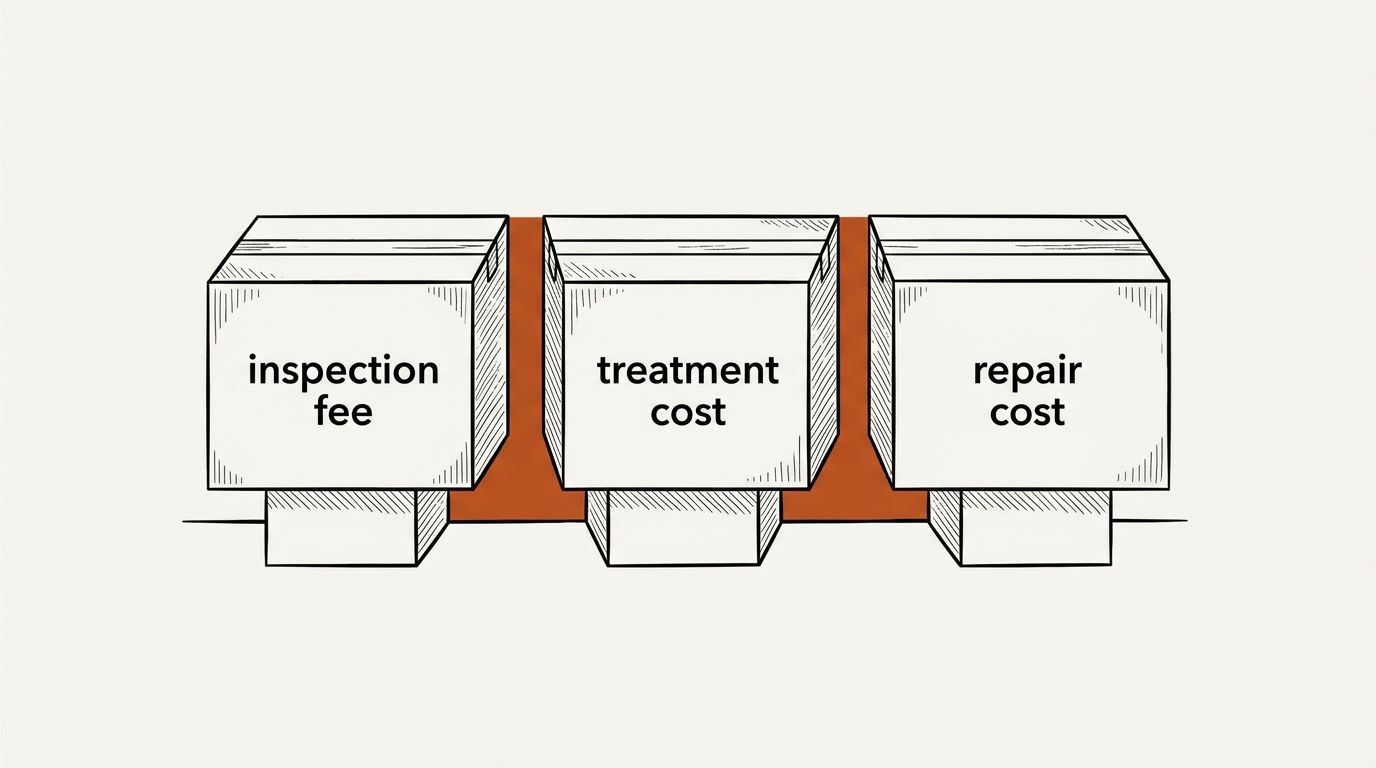
Form NPMA-33 spells out exactly when a treatment recommendation is required: “Treatment or corrective action should be recommended if live termites are found. If no evidence of a previous treatment is documented and evidence of infestation is found, even if no live termites are observed, treatment or corrective action by a licensed pest control company should be recommended.” It adds a narrower case too: “Treatment or corrective action may be recommended if evidence of infestation is observed, and a documented treatment occurred previously, unless the structure is under warranty or covered by a service agreement with a licensed pest control company.”
An inspector’s report cannot serve as an estimate or assessment of structural damage. The form is explicit about it: “This report is not a guarantee or warranty as to the absence of wood destroying insects nor is it a structural integrity report. The inspector’s training and experience do not qualify the inspector in damage evaluation or any other building construction technology and/or repair.” Pricing repair scope and cost is a separate job for a qualified contractor, not the inspector who found the problem.
Here is what I would actually do
Here’s what I’d actually do if I were buying a home and navigating this checklist: treat the inspection fee, the chemical treatment, and any structural repairs as three separate negotiations rather than one expense. First, check with the lender to see whether the loan requires Form NPMA-33 at all. On a VA loan you can check the geography yourself first, in my lookup of where VA requires a wood-destroying insect report. If an inspection shows past infestation, ask the seller for written treatment records and any active transferable warranty before negotiating credits or treatment. I haven’t seen your purchase contract or your house, so review your specific contract terms with your agent or attorney before you act on any of this.
Sources
- Termites: How to Identify and Control Them — US Environmental Protection Agency, updated 2025-10-21. Accessed 2026-08-06.
- Circular 26-22-11: Pest Inspection Fees and Repair Costs — Veterans Benefits Administration, US Department of Veterans Affairs, published 2022-06-15. Accessed 2026-08-06.
- Circular 26-22-11 Change 1: Pest Inspection Fees and Repair Costs — Veterans Benefits Administration, US Department of Veterans Affairs, published 2022-07-28. Accessed 2026-08-06.
- Form NPMA-33: Wood Destroying Insect Inspection Report — National Pest Management Association, hosted by the US Department of Housing and Urban Development, form dated 2019-07-01. Accessed 2026-08-06.
Common questions
Is the seller legally required to pay for the termite inspection?
No. Nothing in the federal or state record assigns the inspection fee to either side by default. It's a term of your purchase contract, the same as who pays for the survey. If someone tells you it's required, ask them to point to the clause, because on a standard contract there isn't one.
Does VA require veterans to pay for the termite inspection?
No, and that's the detail people get backwards. VA Circular 26-22-11 authorizes charging the veteran where the Notice of Value requires the inspection; it doesn't mandate it. The circular's own language encourages veterans to negotiate the cost with the seller rather than assuming it's automatically theirs.
If the inspection finds termites, who pays for the treatment?
That's a separate negotiation from the inspection fee, decided on its own. The NPMA-33 form keeps its findings and its recommendations in separate sections, and the form says the inspector isn't qualified to price a repair. Ask for the seller's treatment records and any transferable bond before you discuss a credit.
- who pays
- va loan
- wdi
- home buying
Related reading
A termite inspection in a house purchase is a visual examination of the parts of a building one licensed inspector could reach on one day, written up on a form your lender reads.
real-estate
Termite Letter Requirements, State by State
A termite letter is a report from a licensed pest control company saying whether it found termites or other wood-eating insects at a house. Your lender will usually want one before you close.
Form NPMA-33 is the wood destroying insect report your lender asked for, the WDI report on your paperwork, and it records the visible evidence one inspector could reach on one day.