 Termite Registry
diy
Do Termite Home Remedies Work?
Termite home remedies are non-commercial recipes, retail oils, or DIY physical tactics used to kill insects without hiring a contractor. Most fail because they rely on direct contact inside hidden timber, leaving the main colony unharmed while wood damage continues silently.
You are not out of time today. Termites eat wood slowly enough that taking a couple of weeks to compare proven methods will not compromise your home.
What follows sorts which of these have real evidence behind them, which are simply untested, and where a DIY fix is actually the right call.
How do orange oil treatments work against termites?
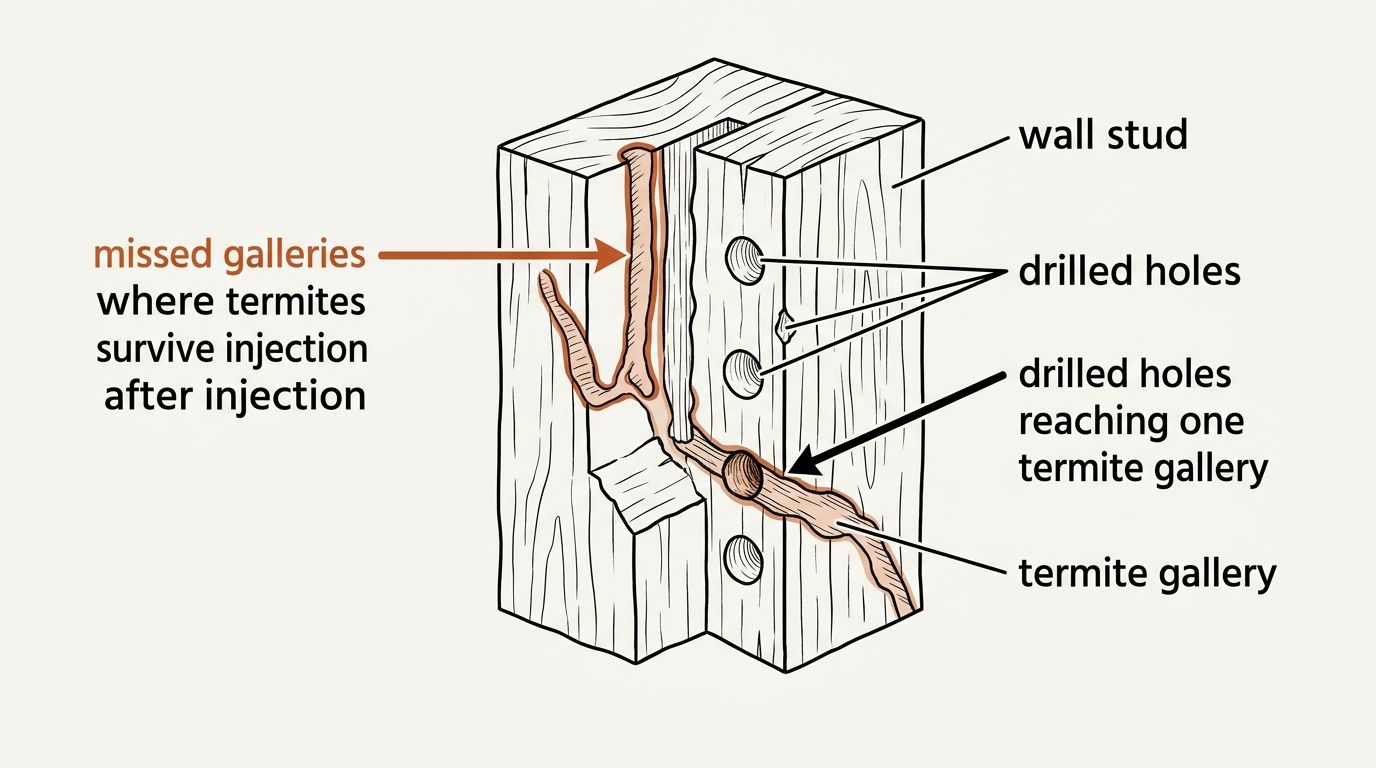
Orange oil works only when injected directly into every active gallery, the tunnel a termite hollows out inside wood, but university tests question its reliability in field conditions.
UC IPM notes that lab and field tests from two universities question the efficacy of d-limonene, the main active ingredient in orange oil. Because orange oil is sold primarily as a localized spot treatment, its success depends entirely on locating every gallery hidden inside your walls.
In an article published by the Bio-Integral Resource Center, Bill Mashek, a licensed California pest control operator who owns a termite company, and editor William Quarles noted that no published field efficacy studies exist for orange oil. Instead, the industry relies on operator callback estimates, which range between 5% and 15%.
Orange oil is also not persistent. According to industry data cited in the article, the smell lingers for 3 to 10 days, and any insecticidal action disappears once the smell fades. Because missed galleries survive, companies rarely warranty an entire structure based on a local orange oil treatment alone unless they supplement it with other products.
Can boric acid or borate treatments eliminate termites?
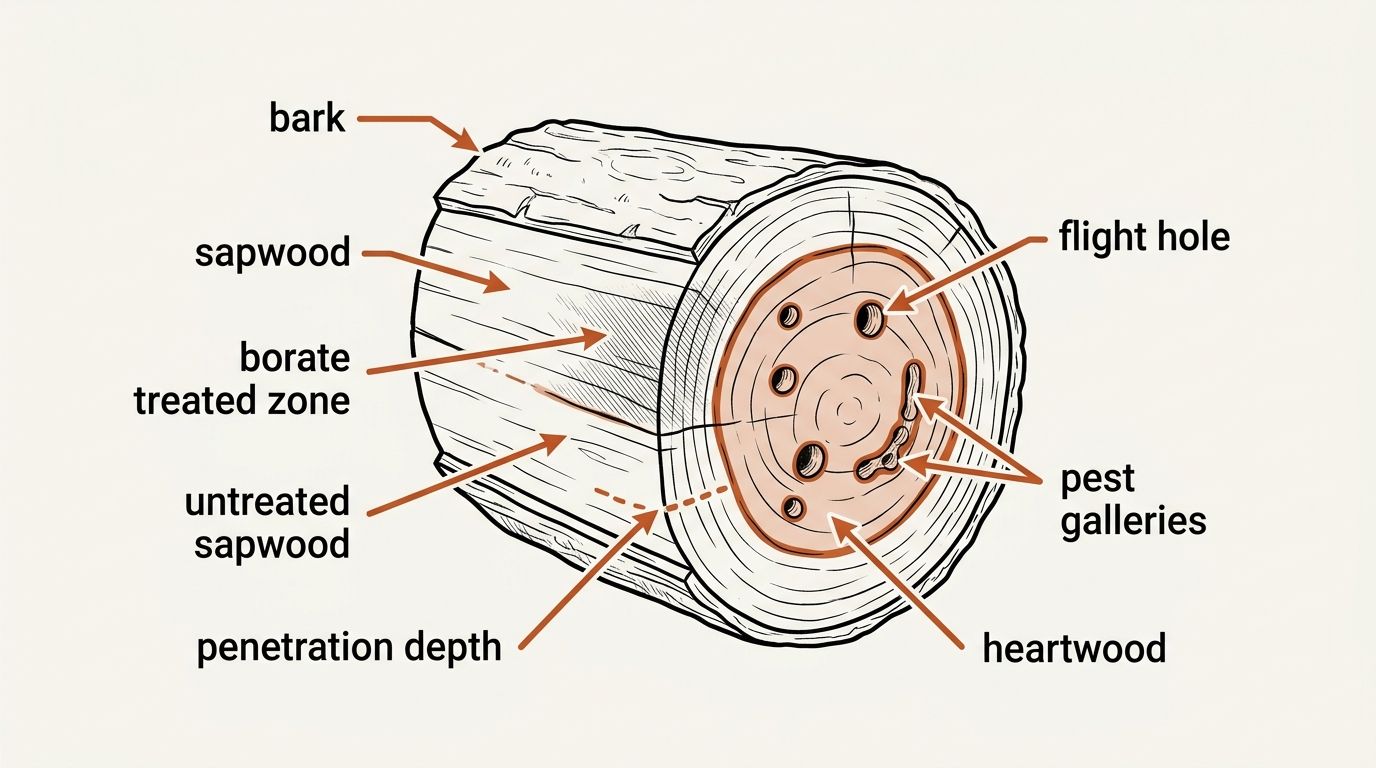
Sprinkling boric acid powder only kills the few termites that touch it, whereas registered borate products, boron-based wood preservatives, require direct application to bare wood to protect timber.
The EPA states that contact-only products are only intended to kill termites that directly touch the pesticide, not the entire infestation. This is why brushing consumer boric acid onto painted wood or dusting it along baseboards fails to reach the colony inside the framing.
Registered wood-treatment products like Bora-Care use a 40% concentration of disodium octaborate tetrahydrate. The Bora-Care label requires application to bare wood with all paint, sealers, or water repellents removed. For active infestations hidden inside wall voids, the label specifies drilling small holes into the timber to inject the solution directly into the galleries.
The Bora-Care label explicitly warns that heartwood, a timber’s dense inner core, is not penetrated quickly. The University of Arizona Cooperative Extension confirms that post-construction borate efficacy varies based on penetration depth, providing good protection only in the specific areas treated. Before picking a product, termite sprays and killers breaks down how registered products differ from surface powders.
Do kitchen remedies like vinegar, garlic, or diatomaceous earth kill termites?
Kitchen ingredients like vinegar, garlic, and cayenne pepper lack scientific testing and precise application instructions, making them unproven for structural infestations.
Penn State Extension explicitly advises against using home remedies like dish soap, vinegar, salt, garlic, vegetable oil, or cayenne pepper. They report that these household items carry no precise instructions, may fail to work, can harm humans or plants, and can violate federal law when used as unregistered pesticides.
The National Pesticide Information Center points out that complex pest situations like termites are too extensive for DIY kitchen recipes. Without a product label, there is no guidance on safe application rates, protective gear, or structural limits.
Diatomaceous earth gets recommended constantly online, but the National Pesticide Information Center lists it as registered for bed bugs, cockroaches, crickets, fleas, ticks, and spiders. The word termite does not appear anywhere on their official fact sheet.
Do beneficial nematodes or biological controls work on termites?
Nematodes, microscopic worms that attack insects, and biological fungi can kill termites in laboratory dishes, but field applications remain unproven and commercially unavailable for home structures.
The EPA notes that biological control agents like nematodes and fungi have demonstrated some success in laboratory settings. However, moving those results into a real house has proven difficult.
UC IPM rates biological control field efficacy for drywood termites as having no information, calling it unreliable at this time and noting that most attempts have been reported as failures. The University of Arizona Cooperative Extension notes that while fungi such as Metarhizium anisopliae and Beauveria bassiana show lab efficacy against drywood termites, no commercial products are currently available for homeowners.
Do ultrasonic or electromagnetic pest repellers drive away termites?
Ultrasonic and electromagnetic devices have no entomology finding behind them, only a regulatory one.
In 2001, the Federal Trade Commission sent warning letters to more than 60 manufacturers and retailers of ultrasonic pest-control devices. The FTC stated that any efficacy claims made in advertising must be backed by scientific evidence.
Previous FTC complaints explicitly alleged that ultrasound devices do not control insects. Between 1985 and 1997, the FTC brought law enforcement actions against six separate companies for making unsubstantiated claims that sound devices could eliminate rodent infestations, repel insects, or replace conventional pest control.
Is moisture control and wood replacement effective against termites?
Fixing leaks and replacing rotted timber is usually enough to control dampwood termites, but moisture control alone will not clear a drywood termite infestation.
The University of Florida IFAS Extension confirms that drying out the infested area is usually enough to control dampwoods. Dampwood species need consistently high timber moisture to survive, so fixing the water source breaks their survival cycle.
Drywood termites operate under completely different rules. The University of Arizona Cooperative Extension notes that drywood termites prefer wood with 10 percent moisture content but can survive on as little as 2.5 to 3 percent moisture by extracting water during digestion. They require no soil contact or external water source, meaning moisture reduction will not stop them.
For localized structural damage, wood replacement is a proven physical fix. The University of Arizona Extension recommends removing and replacing damaged timber with pressure-treated wood. The University of Kentucky Department of Entomology allows one exception to calling a professional: “a mailbox post or other small wooden object not attached to the house.”
What I would do if I found termite signs today
Here is what I would actually do if I suspected termites in my own home.
First, I would figure out which insect I was looking at before spending a dollar on supplies. Subterranean and drywood termites require completely different strategies, and a remedy that works on damp timber will do nothing for dry framing. The subterranean vs drywood termites guide or a termite scan will confirm what you have.
Second, I would rule out untested kitchen recipes right away. Sprinkling diatomaceous earth or spraying vinegar onto baseboards creates a false sense of security while insects continue eating the interior of the wood.
If the infestation turned out to be isolated to an unattached wooden post or a single strip of removable trim, I would remove and replace the wood myself using pressure-treated lumber. If the damage involved structural wall framing, I would skip retail home remedies entirely and get three written quotes from licensed professionals.
I have not seen your house, and I cannot inspect your wall voids. Take a few days to look at the physical evidence, check the wood species and moisture levels, and insist on seeing product labels before agreeing to any treatment plan. For preventing future subterranean visits through structural maintenance, see termite prevention.
Sources
- Pest Notes: Drywood Termites (Publication 7440) — UC Statewide IPM Program, revised 2014. Accessed 2026-08-06.
- Termites: How to Identify and Control Them — US Environmental Protection Agency, updated 2025-10-21. Accessed 2026-08-06.
- Pesticide product label, Bora-Care, EPA Reg. No. 64405-1 — Nisus Corporation, EPA notification accepted 2023-08-04. Accessed 2026-08-06.
- Are Home Remedies a Good Solution? Penn State Extension Says No! — Penn State Extension, updated 2025-05-08. Accessed 2026-08-06.
- Pesticide Home Remedies — National Pesticide Information Center, Oregon State University. Accessed 2026-08-06.
- Diatomaceous Earth General Fact Sheet — National Pesticide Information Center, Oregon State University. Accessed 2026-08-06.
- Drywood Termites (AZ1232) — University of Arizona Cooperative Extension, revised 05/09. Accessed 2026-08-06.
- Termite Prevention and Control (IN1277) — University of Florida IFAS Extension. Accessed 2026-08-06.
- FTC Warns Manufacturers and Retailers of Ultrasonic Pest-control Devices — US Federal Trade Commission, published 2001-05-03. Accessed 2026-08-06.
- Mashek, B. and Quarles, W. (2008). Orange oil for drywood termites: magic or marketing madness? — Bio-Integral Resource Center, IPM Practitioner XXX(1/2), January/February 2008. Accessed 2026-08-06.
- Termite Control: Answers for Homeowners (ENTFACT-604) — University of Kentucky Department of Entomology, revised March 2026. Accessed 2026-08-06.
Common questions
Is boric acid a real termite treatment?
Registered borate wood treatment is real; sprinkled boric acid powder is not the same thing. The registered product, applied per its label, only works on bare wood with paint or finish stripped off, and the label itself says heartwood is not penetrated quickly. A product that only kills on contact was never going to reach a colony inside framing from a dusting on top of it.
Does orange oil actually work on termites?
It kills termites it contacts, in laboratory conditions. No published study has measured its field efficacy, so the industry's own honest number is a practitioner-reported callback rate of 5 to 15 percent, meaning that fraction of treated homes see termites again. It is not persistent, and the smell fading is a rough sign the insecticidal action has too.
Do ultrasonic termite repellers work?
There's no entomology finding behind them, only a regulatory one. The FTC brought enforcement actions against six companies between 1985 and 1997 over unsubstantiated claims, then sent warning letters to more than 60 manufacturers and retailers in 2001 saying efficacy claims must be backed by scientific evidence. Its own case history states plainly that prior complaints alleged these devices do not control insects.
- diy
- home remedies
- orange oil
- boric acid
Related reading
identification
Subterranean vs Drywood Termites: Which You Have
Subterranean termites nest in the soil and reach your wood through mud tubes; drywood termites live entirely inside dry wood and touch no soil at all.
prevention
Termite Prevention: What Actually Works
Termite prevention is mostly drainage and carpentry. Keep wood at least 6 inches clear of the soil, move water away from the foundation, pull mulch back from the siding, and get rid of the buried…
A can of termite spray kills the termites it touches. It does not control an infestation, and that is not my opinion, it is a distinction the US Environmental Protection Agency enforces in writing.